This original exercise uses 164 beats per minute and a break you create yourself. You do not need to download a famous break or assume that widespread circulation means a recording is cleared for release. Ableton's jungle production demonstration shows how drum sampler processing can support the style; the pattern below is independent practice material.
Make a source break at a slower tempo
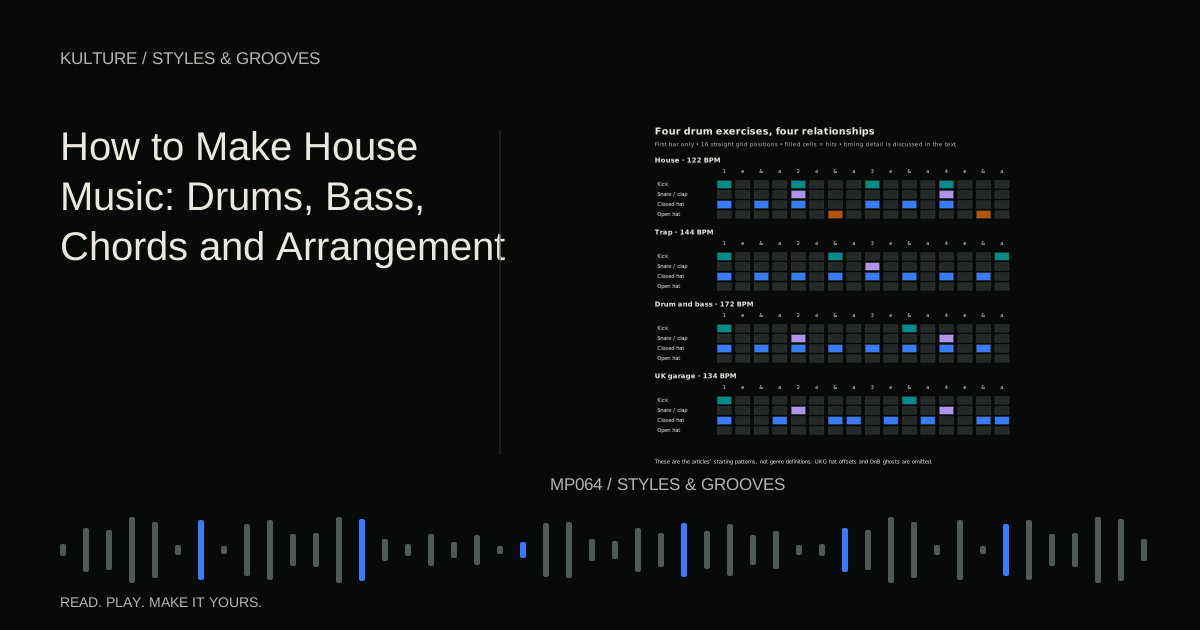
At 100 BPM, program two bars using an acoustic style drum kit. Put snares on beats 2 and 4. Place kicks on bar 1, beats 1 and 3 and; bar 2, beats 1, 2 a, and 3 and. Add eighth note hats and quiet ghost snares on bar 1, 3 e and bar 2, 4 a.
Vary hat and ghost note strength. Add a small amount of room ambience if it helps the kit feel connected, but keep the main transients clear. Render the two bars to audio. Save the dry drum MIDI or original recording so you can revise it later.
The rendered file contains interactions between drum hits and their tails. That continuity is part of what distinguishes chopping a break from simply triggering isolated one shot samples.
TRY IT HERE
Find the pocket
Tap the grid, change the tempo and hear your pattern.
Ready when you are. Audio starts only when you press Play.
Keep experimenting in the beat maker LabChoose the speed and pitch relationship
Bring the break into a 164 BPM project. You have two main options. Time stretch it to fit while approximately preserving pitch, or use resampling so faster playback also raises pitch.
Going from 100 to 164 BPM requires a speed ratio of 1.64. Resampling at that ratio raises pitch by approximately 8.6 semitones. The drums become shorter and brighter as well as faster. This is a substantial change, so choose by sound rather than assuming pitch preserving stretching is always superior.
If the stretched version smears snare attacks, try a transient oriented algorithm, smaller slices, or the resampled version. If the resampled drums become too thin, start with a lower pitched source kit or use a different source tempo.
Slice useful gestures, not only individual hits
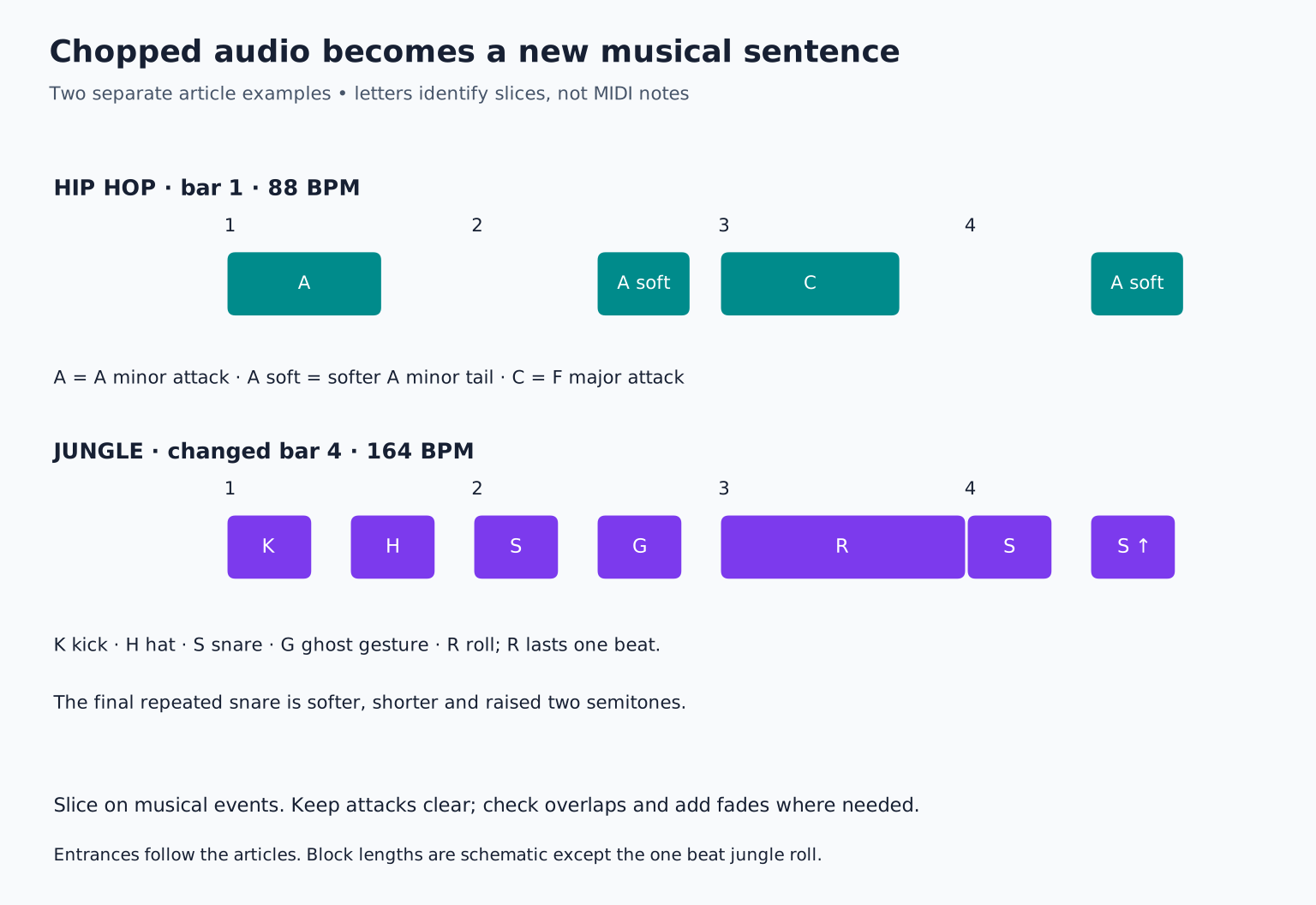
Make slices at major attacks and also preserve some longer gestures. Create labels such as K for kick with tail, S for main snare, H for hat fragment, G for ghost snare fragment, and R for a short rolling passage.
Keep enough sound after each attack to retain the room and cymbal character. Very tight slicing can turn a distinctive break into sterile one shots. On the other hand, long overlapping slices may double background hats and blur the rhythm.
Configure whether a new slice stops the previous one. Monophonic or choke behavior can make edits crisp, while overlapping playback can preserve tails. Test both. Add short fades at exposed cuts, and avoid trimming away the actual attack just to make the waveform look tidy.
Build a four bar drum sentence
Use the first two bars to establish the source groove. In bar 3, keep the snare anchors on 2 and 4 but replace the area after beat 3 with a short ghost note response. In bar 4, make a clear turnaround.
A reproducible turnaround is:
- Beat 1: K.
- Beat 1 and: H.
- Beat 2: S.
- Beat 2 and: G.
- Beat 3: R, trimmed to last one beat.
- Beat 4: S.
- Beat 4 and: S again, softer and slightly shorter.
The repeated snare at the end announces the return. If it sounds too busy, remove G or shorten R. Keep the beginning of the next phrase strong enough that the fill resolves rather than merely continuing indefinitely.
Now pitch only the final repeated snare up two semitones. This changes the fill's color without transposing the whole break. Compare with the unpitched version and keep the gesture only if it improves the phrase.
Preserve the break's hierarchy
Listen for three layers of importance: the main kick and snare, the ghost note conversation, and the background texture. If all slices play at the same loudness, the break can become a wall of equally emphasized attacks.
Lower secondary slice velocities or clip gains. Use a different slice where the recorded hit itself is softer; reducing a loud snare's volume is not always the same as a naturally quiet articulation.
Avoid layering a new snare over every original snare immediately. If reinforcement is necessary, choose a short complementary sound and check timing and polarity. A layer should solve a specific weakness without erasing the source's identity.
Let the bass move more slowly
Use a clean monophonic sub or rounded synth bass in F minor. Write F on bar 1, beat 1, held for two beats; C on beat 3 and for half a beat. In bar 2, use E flat on beat 1 for one beat and F on beat 3 for one beat.
In bars 3 to 4, answer with D flat held across the first half of bar 3, then E flat and F as shorter notes in bar 4. Leave space during the busiest snare turnaround. The bass's slower contour gives the fast break a stable foundation.
If you add a rougher upper bass layer, keep the sub behavior controlled and check that both layers follow the same intended pitch. Do not widen the low foundation just because the pads are wide.
Create atmosphere with contrast
Use a pad on F, A flat, C for four bars, then D flat, F, A flat for four. Let it evolve slowly while the drums remain active. Add one high melodic landmark, perhaps C, E flat, F, only near the end of every eight bar phrase.
A self recorded vocal fragment or sound effect can act as a section cue. Keep its permission and source clear. If it has a recognizable pitch, check it against the harmony rather than treating every vocal as unpitched percussion.
Arrange the break as a performance
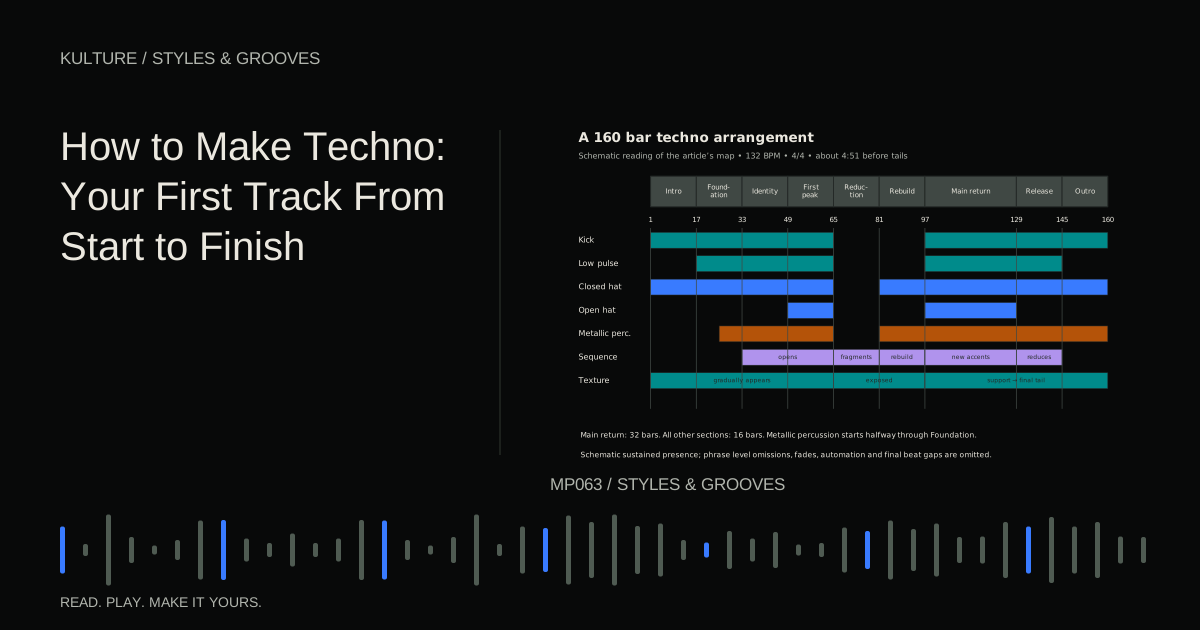
Try 128 bars, approximately 3 minutes 7 seconds. Introduce pad and a filtered break fragment for 16 bars, establish bass and full drums for 32, reduce to atmosphere and sparse slices for 16, return with a new four bar drum variation for 48, then exit over 16.
Keep some stretches nearly unchanged so the listener learns the groove. Save the most dramatic chop for a meaningful boundary. Constant maximal editing removes the contrast that makes a surprising fill effective.
Check the exported track for clicks, unexpected slice overlaps, and low end buildup. Your exercise is to create three four bar variations from the same source: one restrained, one rolling, and one fragmented. Arrange them in an order that increases then releases tension. Continue with drum and bass production to compare a more programmed approach, and sampling permissions before using outside recordings.
TAKE IT INTO YOUR OWN MUSIC
Your next session.
Try 128 bars, approximately 3 minutes 7 seconds. Introduce pad and a filtered break fragment for 16 bars, establish bass and full drums for 32, reduce to atmosphere and sparse slices for 16, return with a new four bar drum variation for 48, then exit over 16.
Notes and progress stay in this browser.