“Tune it to the song” does not usually mean turning every note into the song's tonic. It means making the instrument track pitch accurately so you can play the appropriate notes for the harmony.
Separate three different pitch decisions
The source pitch is the pitch already present in the sample. The sampler's root mapping tells the instrument how that source relates to the keyboard. The written bassline chooses which notes to play in the song.
If the source is F but the sampler treats it as C, pressing C may produce F. Writing different MIDI notes to compensate can work temporarily, but it makes later editing confusing. Correct the mapping so the piano roll describes the intended music.
Octave labels can differ between DAWs. A note called C3 in one application may be called C4 in another. Use MIDI note numbers or a tuner when a tutorial's octave naming causes uncertainty.
TRY IT HERE
Give the bass some space
Tap steps to add rests. Change the register or slide.
Ready when you are. Audio starts only when you press Play.
Keep experimenting in the synth LabInspect the sound before measuring
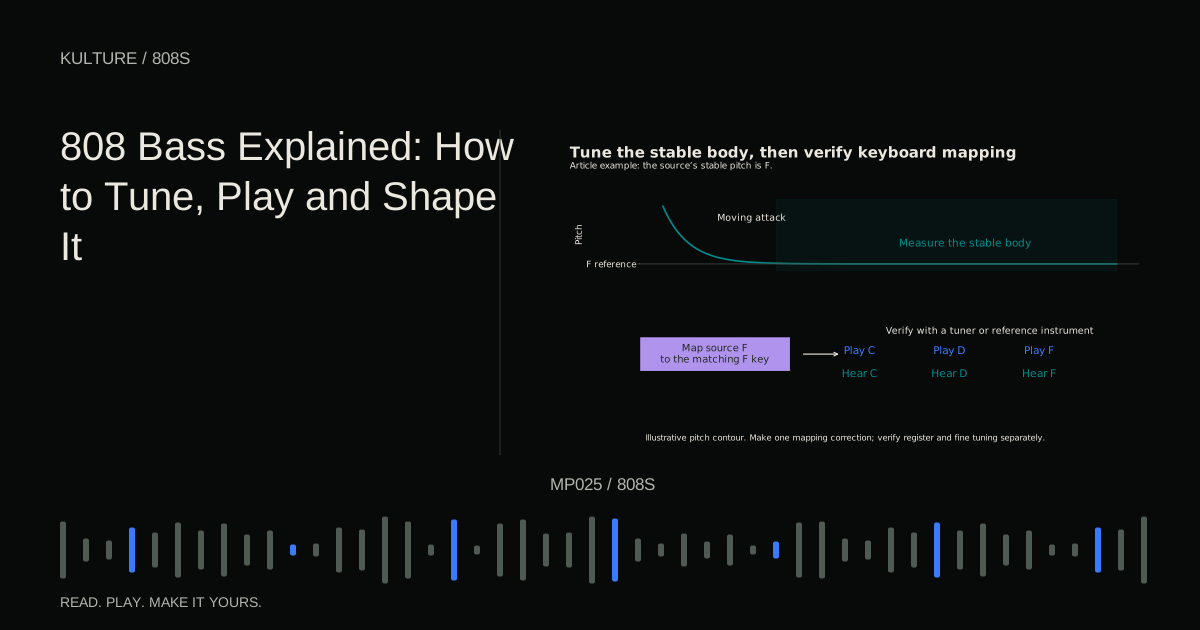
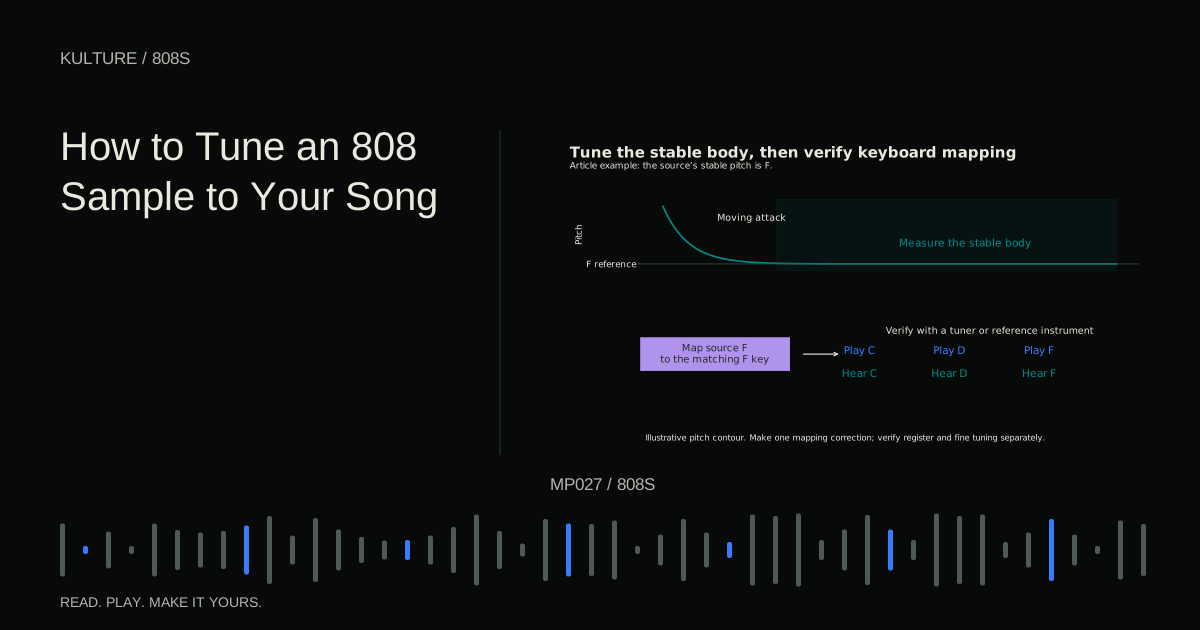
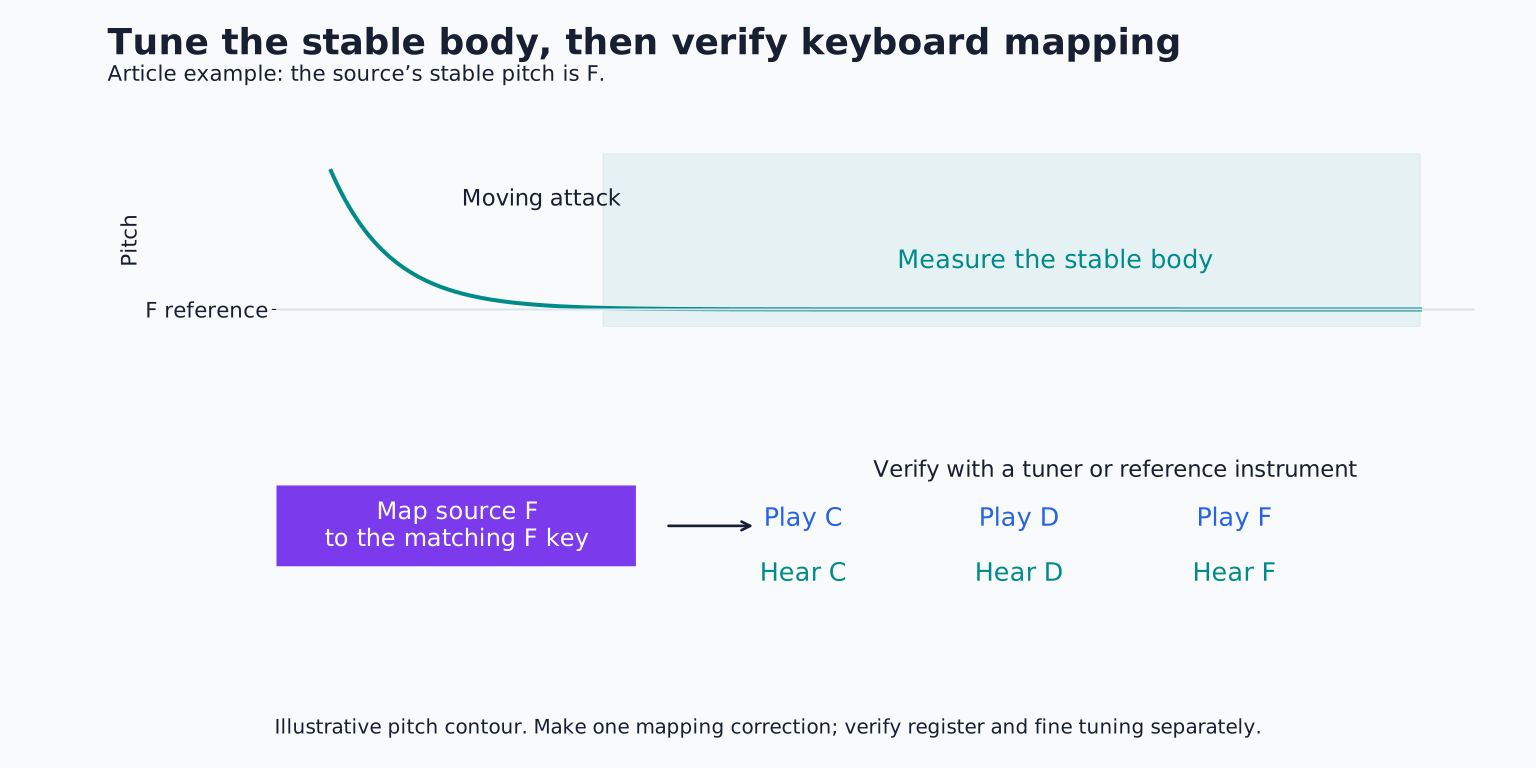
Load the sample without additional distortion, chorus, reverb or pitch effects. Play a single note and listen to its attack, body and tail. A quick falling pitch at the beginning is common in 808 style sounds and may not represent the stable bass pitch.
Roland's discussion of 808 bass provides context for the sound's use as a pitched instrument. Your tuning task concerns the sustained musical component, not necessarily the first instant of the transient.
If the entire sample continuously falls in pitch, there may be no single stable root. You can choose a musically useful reference portion, shorten the moving section, or select a more stable sample. Do not expect a tuner to settle on a note that the sound never holds.
Measure the stable portion
Place a tuner after the sampler and trigger one note long enough to hear the tail. Watch whether the reading stabilizes after the attack. If the low pitch is difficult to detect, temporarily transpose playback up one or two octaves.
An octave shift preserves the pitch class, so an F remains an F at the higher register. Remember the temporary shift when returning to the intended bass range. Also compare with a plain piano or sine based reference note; a tuner reading should agree with your listening.
Some analyzers display the strongest harmonic rather than the fundamental. A reading an octave above the perceived bass may still indicate the correct pitch class. A less predictable reading can mean the sound is noisy, heavily distorted, layered or still moving in pitch.
Correct the root mapping once
Suppose you determine that the untransposed sample's stable body is F. In a sampler with a root key assignment, identify F as the sample's original reference note at the appropriate octave. In a sampler that uses transposition controls instead, adjust playback so a known MIDI key produces its matching pitch.
The interface differs between products. Image Line's channel settings documentation documents its sampler related pitch and keyboard controls. Ableton's instrument reference covers its own sample playback and transposition controls. Use your instrument's method rather than assuming every “root” control behaves identically.
Do not assign F as the root and also transpose by the same interval unless you understand why both changes are needed. Make one correction, test it, and only then make another.
Verify three notes, not one
Play C, D and F in a comfortable register. The tuner should identify the corresponding pitch classes, apart from any intentional attack movement. Compare each with your reference instrument.
This test catches several problems. If every note is the same pitch, keyboard tracking may be disabled. If intervals are wrong, the instrument may use unusual pitch scaling or a special mode. If every note is consistently offset, the root mapping or global transposition is still wrong.
If the notes are correct but all seem an octave too low, correct the register separately. Pitch class and octave are related but distinct checks. A bassline can be harmonically correct and still sit in an impractical range.
Adjust only after the semitone mapping is right
A cent is one hundredth of a semitone. If the stable pitch sits slightly sharp or flat, use a adjust control to bring it closer to your reference tuning. Most common software instruments use A4 at 440 Hz by default, but a project may intentionally use another reference.
Do not chase a fluctuating tuner display with constant edits. Let the stable section repeat, compare by ear and make small adjustments. A decaying, distorted bass sound may not produce a perfectly motionless reading.
If the song includes recorded instruments with a different tuning reference, compare the 808 against those recordings rather than assuming the default reference is the musical target.
Match the notes to the song
Now use the correctly mapped instrument to play the chord roots. For Dm, B flat, F, C, start with D, B flat, F and C. Put one note at each chord change and listen with the harmony.
If the line sounds wrong at a particular transition, the issue may be the composition rather than tuning. A lingering old note can overlap a new chord. A passing note may be held too long. A bass note under an inverted chord can change the overall harmony.
How to Match a Bassline to Your Chords explains those relationships. Tuning makes the instrument predictable; it does not automatically choose the right line.
Check what transposition does to the sample
Ordinary resampling changes playback speed along with pitch. Higher notes can become shorter and lower notes longer. Time stretch modes may preserve duration, but they can introduce different textures or artifacts.
After tuning, play your lowest and highest intended notes. Does the low note last so long that it overlaps the next hit? Does the high note end before its MIDI duration? Adjust the envelope, choose a suitable playback mode or use a source that works across the required range.
Avoid moving a sample through an extreme range simply because the keyboard allows it. A different octave or another sample may produce a more consistent bassline with less corrective processing.
Common false fixes
Changing the song's key to match one mislabeled sample is usually unnecessary. Drawing all MIDI notes several semitones away from their intended names hides the mapping problem. Tuning only the attack can leave the sustained body wrong. Tuning with heavy modulation enabled can make a stable reference impossible.
Also, a correctly tuned 808 can still clash with a long tonal kick. That is a relationship between two sounds, not proof that the sample mapping failed. Diagnose the pair separately using Kick vs Bass.
Save a verified instrument
Once the mapping is correct, save the sampler preset with a clear name and a note about the source pitch if useful. Then play a short scale and a four bar root progression before adding slides or distortion.
Your completion check is simple: the written note produces the intended pitch, the octave is usable, and the sample behaves consistently over the line's range. Continue with How to Write an 808 Bass Pattern only after those checks pass.
TAKE IT INTO YOUR OWN MUSIC
Your next session.
Once the mapping is correct, save the sampler preset with a clear name and a note about the source pitch if useful. Then play a short scale and a four bar root progression before adding slides or distortion.
Notes and progress stay in this browser.