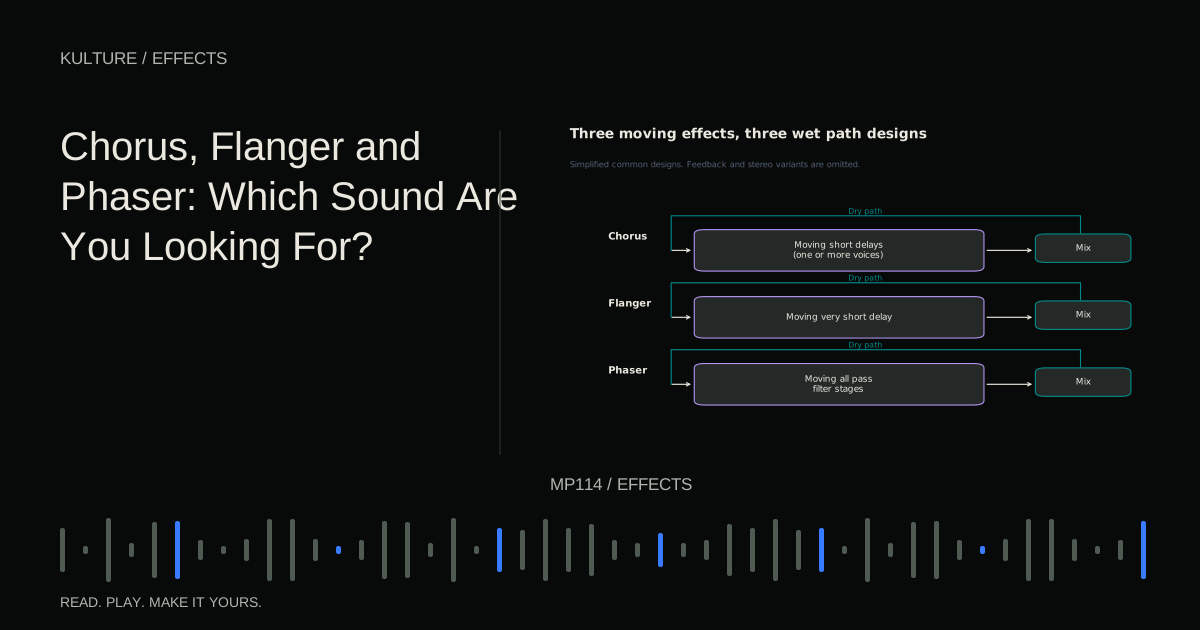
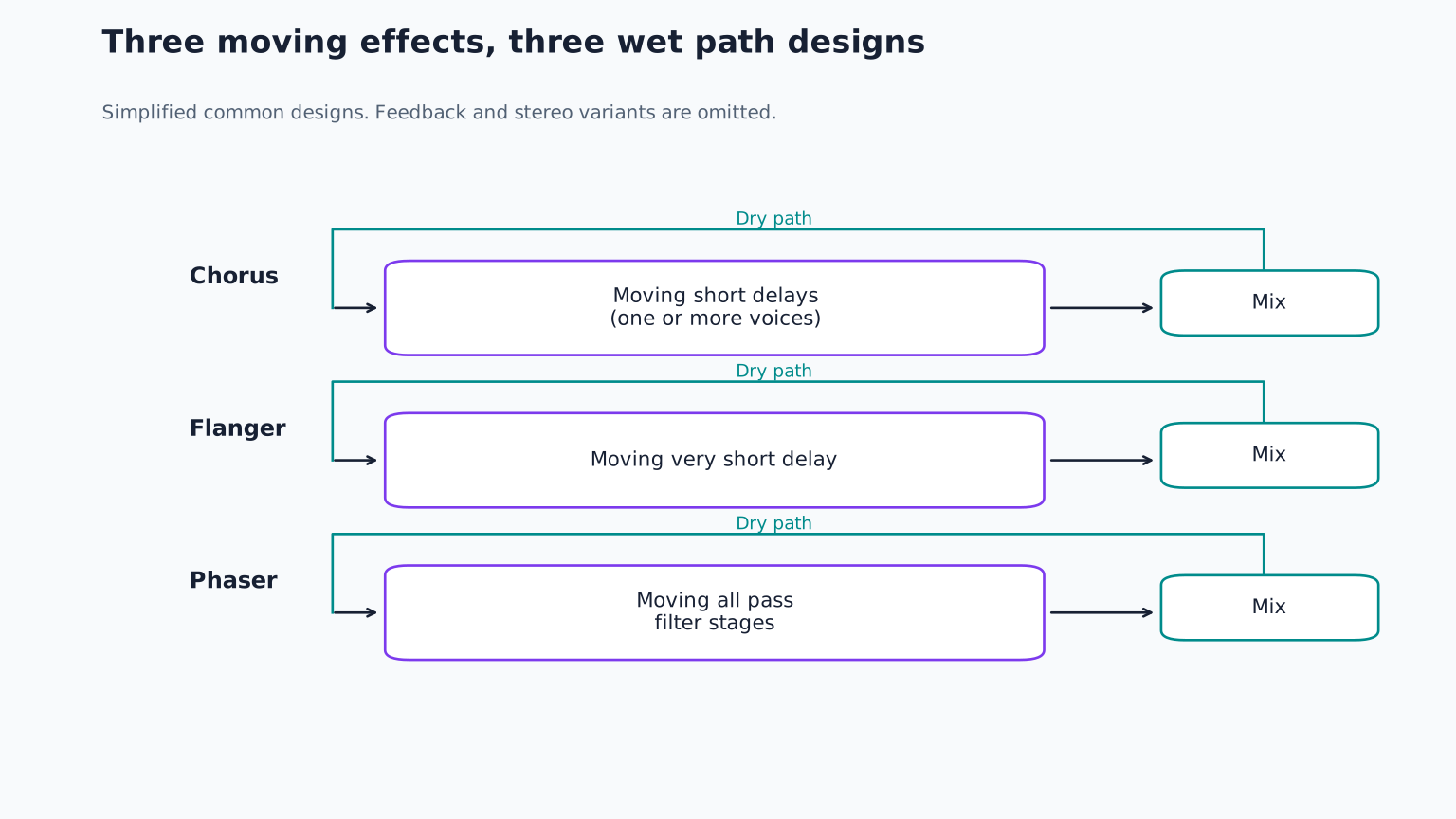
All three create motion by changing the relationship between processed and dry sound. Start with one effect at a time so you can hear its characteristic movement instead of judging a stack of presets.
What chorus is doing
A chorus commonly blends the source with one or more short delayed copies whose delay times move. Changing delay time also changes the copies’ instantaneous pitch, producing small differences that can suggest multiple performers.
The effect can be subtle thickening or obvious wavering. Multiple voices and stereo differences can make it broad, but width is not the only purpose. A mono chorus can still create a changing doubled tone.
Use a sustained keyboard chord and begin with slow rate, shallow depth and a modest wet amount. Listen for a gentle sense of movement rather than a separate echo. Increase depth until the pitch wobble becomes obvious, then reduce it to a useful point.
TRY IT HERE
Build a little movement
Compare modulation on a short original tone.
Ready when you are. Audio starts only when you press Play.
Keep experimenting in the synth LabWhat flanging is doing
A flanger combines very closely related signals with a short, changing delay. Their interference produces a series of peaks and notches, often called a comb filter response. As the delay changes, that pattern moves.
Feedback can make the sweep more resonant and dramatic. Different feedback polarity, delay range and dry/wet relationships create different characters. The familiar jet like sound is one possibility rather than the complete definition.
Eventide’s history of the Instant Flanger discusses the distinction between delay based flanging and phasing. It is useful manufacturer background without requiring that specific effect.
Try a flanger on a sustained bright synth or a drum loop. A source with broad frequency content usually reveals the moving pattern more clearly than a simple sine tone.
What phasing is doing
A phaser typically uses a sequence of all pass filter stages that change phase relationships, then combines that processed signal with the dry sound. The combination creates moving notches in the frequency response.
Unlike a simple flanger’s delay based comb pattern, a phaser’s notch arrangement depends on its filter stages and tuning. This often produces a smoother, vowel like or hollow swirl, although feedback can make it aggressive.
Stage count can affect the complexity of the pattern in processors that expose it. More stages are not automatically better; they give a different response. Eventide’s phasing and flanging discussion offers another manufacturer perspective on the two families.
Compare them on one repeatable phrase
Create a 100 BPM project with a sustained C minor chord: C, E flat and G in a middle register. Hold it for two bars, then leave one bar silent. Use a bright but comfortable synth patch and disable all effects.
Make three versions using chorus, flanger and phaser separately. Start each at a slow modulation rate, perhaps around 0.25 Hz where a hertz based control exists, so a complete cycle takes about four seconds. Use modest depth and wet level initially.
On chorus, listen for multiple slightly different versions of the chord. On flanger, listen for a more pronounced travelling pattern. On phaser, listen for the changing hollow or vowel like regions. These are expected tendencies, not guaranteed results from every preset.
Adjust output levels for a fair comparison. If one effect introduces much more level or resonance, lower it before deciding which movement suits the chord.
Rate and depth solve different problems
Rate controls how fast modulation moves. Depth controls how far it moves, though exact units vary. A slow, deep effect can make a broad sweep; a fast, shallow effect can create a subtle shimmer or wobble.
Change only rate first. Listen at a slow cycle, then a faster one. Restore the preferred speed and change depth. This keeps you from confusing more dramatic motion with faster motion.
Tempo synchronization can make a cycle repeat over a bar or beat division. Free running rates can feel less tied to the grid. Check whether the modulation restarts with playback or notes if repeatability matters to the arrangement.
Wet amount is not a universal strength knob
The relationship between dry and processed signals is part of these effects’ construction. A flanger or phaser can change character substantially when the blend changes, rather than simply becoming a quieter version of the same effect.
On chorus, fully wet operation may resemble vibrato or a modulated delayed source in some designs, because the stable dry reference is gone. Other multi voice designs behave differently. Use the actual processor’s manual and listen.
For a beginner mix, preserve enough stable information that the part remains easy to follow. If the melody’s pitch becomes uncertain, reduce depth or wet level before trying to correct it with EQ.
Fit movement around the song
A chorus can help a background pad occupy a broader space while the lead remains clear. A flanger can emphasize a transition or fill. A phaser can provide rhythmic movement to a repeated chord or guitar part.
Try automating the effect amount for only the final two bars of an eight bar section. The contrast may be more effective than leaving a dramatic sweep active throughout. Stable sections give movement something to contrast against.
Avoid putting equally obvious modulation on every layer. If the bass, chords and lead all wobble independently, the arrangement may lose its centre. Keep one important element dependable and let the others provide motion.
Check mono and low frequency behaviour
Stereo modulation creates differences between channels, and those differences can alter the mono sum. Check whether the part merely becomes narrower or actually loses essential body. If it weakens severely, reduce stereo spread, depth or wet amount, or keep an unprocessed core.
Low frequency modulation can make a bass foundation change in weight over time. That may suit a special effect, but it can be distracting in a stable groove. Consider processing only a higher support layer instead of the entire bass.
For practice, choose one phrase and create a subtle ensemble version, a dramatic sweep and a slow swirl. Write down which effect gave each result and why it fits a possible section of a song. Continue with mono compatibility and layering to preserve clarity while adding movement.
TAKE IT INTO YOUR OWN MUSIC
Your next session.
Stereo modulation creates differences between channels, and those differences can alter the mono sum. Check whether the part merely becomes narrower or actually loses essential body. If it weakens severely, reduce stereo spread, depth or wet amount, or keep an unprocessed core.
Notes and progress stay in this browser.