This tutorial creates an original sample based beat at 88 beats per minute. Instead of sampling a commercial record, you will record your own short keyboard passage, chop it, and rearrange it. The process teaches sampling without assuming that an old recording is free to use. For broader context, Native Instruments' hip hop production guide discusses the relationship between samples, composition, drums, and arrangement.
Make a source worth chopping
Choose an electric piano or another instrument you can record or render. Play one bar each of A minor seventh, D minor seventh, F major seventh, and E minor seventh. The notes are A, C, E, G, D, F, A, C, F, A, C, E, and E, G, B, D.
Play a short chord on beat 1 and a quieter repeat on 3 and. Leave some space after each attack. Use a slightly different voicing or strength on the second hit. Render the four bars to audio, preserving a little tail after the final chord.
You now have your own source performance. Keep its unprocessed version. A source with meaningful dynamics and gaps gives you more useful chop choices than four bars of identical sustained blocks.
TRY IT HERE
Find the pocket
Tap the grid, change the tempo and hear your pattern.
Ready when you are. Audio starts only when you press Play.
Keep experimenting in the beat maker LabSlice according to musical events
Create slices at the chord attacks, not merely at equal time intervals. Name the first attacks A, B, C, and D in their original order. Create a fifth slice from the quiet repeat of the A minor chord and call it A soft.
Set each slice's start just before the attack so the transient remains intact. Trim or fade the end to avoid clicks, but do not remove all the natural decay. If using a sampler, decide whether one slice should stop another through a choke group or whether tails should overlap.
Try this two bar sequence:
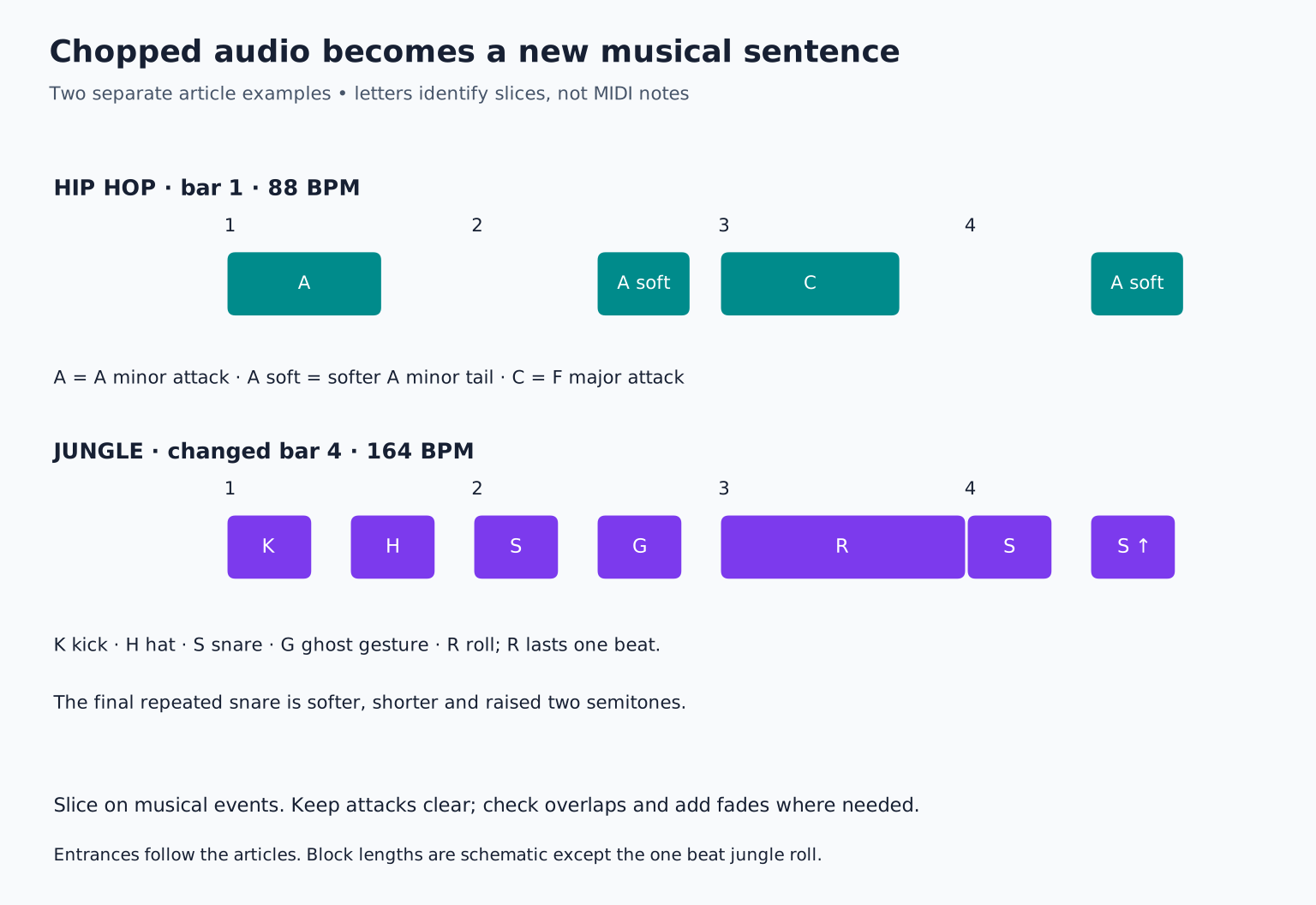
- Bar 1: A on beat 1, A soft on 2 and, C on beat 3, A soft on 4 and.
- Bar 2: B on beat 1, B again on 2 a, D on beat 3, then silence on beat 4.
The actual chop sequence is A minor, A minor, F major, A minor in bar 1, then D minor, D minor, E minor in bar 2. The short A soft return on bar 1, beat 4 and is part of the harmony, not just a percussion accent. You have transformed the performance through selection and timing rather than merely looping it unchanged.
Decide whether pitch or timing should change
Traditional resampling changes pitch and duration together: faster playback raises pitch and shortens the sound. Time stretching attempts to change duration independently of pitch. Each can be useful, and each has artifacts.
For this exercise, keep the sample at its original pitch and trigger slices rhythmically. If you transpose everything down two semitones, update the bass notes to match: A becomes G, D becomes C, F becomes E flat, and E becomes D. Do not leave the bass in the old key simply because its MIDI pattern looks correct.
If stretching makes chord attacks blurry, use shorter slices or a different algorithm suited to the material. If a slice ends abruptly before the next one, extend its tail or intentionally leave the gap. Not every gap needs to be concealed.
Build drums around the sample's accents
Place snares on beats 2 and 4. Use kicks on bar 1, beats 1, 2 a, and 3 and; in bar 2, use beats 1, 3, and 4 and. Add closed hats on eighth notes, with quieter hits between stronger accents.
The sample already has rhythmic activity, so do not automatically add sixteenth hats. Listen to the sample and snare together. If their attacks clash, move a sample chop or remove a drum hit before applying swing to everything.
Try placing the snare very slightly later while leaving kick timing stable, then compare with the on grid version. The amount should serve the phrase. A late snare is not a universal requirement for hip hop, and excessive delay can make the beat drag.
Add one ghost snare in bar 2 on 3 a, much quieter than the main backbeats. It should connect the groove, not sound like an extra main snare.
Write bass from the chopped harmony
Follow the actual chord under each moment. In bar 1, play A on beat 1 and F on beat 3; end the F before beat 4 and, where the A soft chop returns to A minor. Leave that final chop without bass initially. In bar 2, play D on beat 1 and E on beat 3. Use a simple rounded bass with note lengths that stop before important kick attacks where necessary.
Now add a short E pickup on bar 2, beat 4 and, leading back to A. If that pickup competes with the kick there, either remove the kick or move the bass pickup. A bassline should not be forced to double every drum hit.
Check whether the source sample already contains low notes. If so, move your bass to a complementary register or reduce the sample's low end carefully. Two bass performances playing similar but not identical notes can create confusion that no compressor will solve.
Arrange for an imagined performance
Create a 56 bar draft: 4 bar intro, 16 bar verse, 8 bar hook, 16 bar verse, 8 bar hook, and 4 bar ending. At 88 BPM this lasts about 2 minutes 33 seconds.
During verses, use the core chops and drums. During hooks, add a simple upper response or let more of the original chord tails overlap. In the second verse, remove the sample for one beat at the end of every fourth bar, leaving the drums to answer.
Record a rough spoken or hummed guide to test space. The words do not need to be final. If every line ending fights a fill, simplify the instrumental. A beat's arrangement changes when a real performance arrives; leave room for that collaboration.
Keep texture from becoming damage
Saturation, filtering, and noise can add character, but do not assume hip hop requires dullness or distortion. Add one color process and compare it with the clean version at similar loudness. If the snare loses its useful attack or the chord identity disappears, reduce the effect.
Check sample boundaries for clicks, bass notes for overlap, and the full ending for cut off tails. Save the source recording, chopped version, and project media together. If you later substitute a commercial sample, investigate permission before release; the creative technique does not determine clearance.
Your exercise is to make two chop patterns from the same four bar source without changing the drums. Choose the one that leaves a more convincing vocal pocket. Then study reference tracks without copying and sample pack licenses as you expand your source library.
TAKE IT INTO YOUR OWN MUSIC
Your next session.
Saturation, filtering, and noise can add character, but do not assume hip hop requires dullness or distortion. Add one color process and compare it with the clean version at similar loudness. If the snare loses its useful attack or the chord identity disappears, reduce the effect.
Notes and progress stay in this browser.