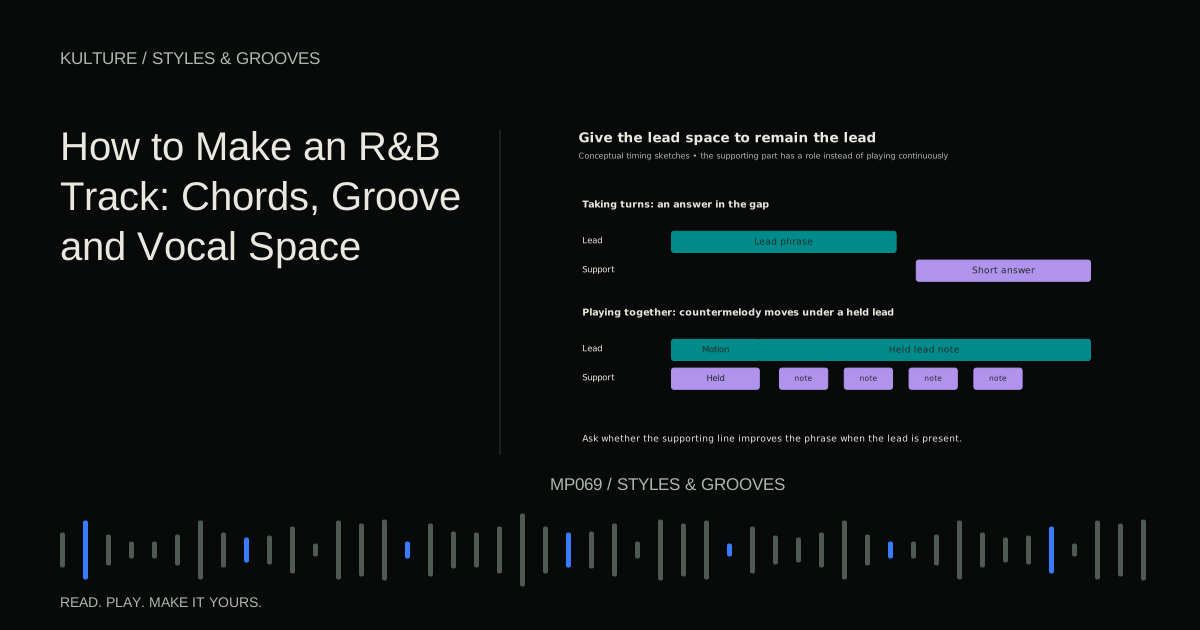
This original example uses 76 beats per minute in 4/4, a soft electric piano, a rounded bass, restrained drums, and a four bar vocal idea. R&B spans many eras and approaches; extended chords and laid back timing are options, not requirements for every track.
Build harmony that moves smoothly
Use these four chords, one bar each:
| Bar | Chord | Notes |
|---|---|---|
| 1 | D minor ninth | D, F, A, C, E |
| 2 | G dominant ninth | G, B, D, F, A |
| 3 | C major ninth | C, E, G, B, D |
| 4 | A minor seventh | A, C, E, G |
The ninth is the scale's second degree placed above the seventh chord framework. You do not need to play every note in every register. Let the bass supply roots while the keyboard uses compact upper voicings: F, A, C, E, F, A, B, D, E, G, B, D, and E, G, A, C.
Notice that some notes remain while others move by a small distance. This is voice leading: individual chord tones connect smoothly rather than every chord jumping as a rigid block. The voice leading lesson develops that skill.
Play each voicing on beat 1 and a lighter, shorter repeat on 3 and. In bar 4, omit the repeat to leave space for a turnaround. Keep the keyboard above the bass register so the extended harmony does not become a low frequency cluster.
TRY IT HERE
Build it. Hear it.
Change one note and listen to the relationship.
Ready when you are. Audio starts only when you press Play.
Keep experimenting in the beat maker LabEstablish a groove that can breathe
Place a rim or soft snare on beats 2 and 4. Use kicks on bar 1, beat 1 and 3 and; bar 2, beat 1 and and 3; bar 3, beat 1 and 2 a; bar 4, beat 1 and 3 and. Add quiet eighth note hats, leaving occasional gaps around vocal pickups.
Rather than shifting every hit late, begin with stable kicks and snares. Play or nudge a shaker layer slightly around the grid, preserving a repeating accent pattern. A subtle contrast between stable and loose elements can feel more convincing than random timing everywhere.
Native Instruments' discussion of human feeling programming emphasizes the interaction of performance, timing, and sound. Use your ears: visual irregularity alone does not make a groove expressive.
Write bass that supports the harmony
Start with D, G, C, and A at each bar's beginning. Hold each for about a beat and a half, then leave a gap. Add a short fifth on beat 3 and: A, D, G, and E respectively.
In bar 4, add B on 4 and as a passing note into the returning D only if you like the rising motion; alternatively use C sharp as a chromatic approach, but hear its tension carefully. These are optional colors, not required scale rules. A simple A to D return can be stronger.
Keep the bass out of the singer's busiest rhythmic moments. If the bass is performed, preserve useful articulation and dynamics instead of forcing every note to the same length and velocity. If programmed, vary notes for a musical reason rather than randomizing them.
Test the track with an actual melody
Use a guide melody in a comfortable singing range. In bar 1, sing A on beat 1, C on 2 and, and E held from beat 3. In bar 2, answer with D on beat 1, B on beat 2, and A held from 3 and. In bar 3, sing G, E, D in a relaxed descending phrase. In bar 4, hold C, then leave space before the next cycle.
Those notes are suggestions for a study, not a demand that the singer use a fixed octave. Transpose the whole sketch if the range feels strained. The guide's purpose is to reveal where the instruments should stop talking.
Berklee's discussion of prosody describes aligning musical choices with the song's central expression. Here, let the relaxed harmonic motion and spacious phrasing serve the same emotional intention.
Add responses only where they are useful
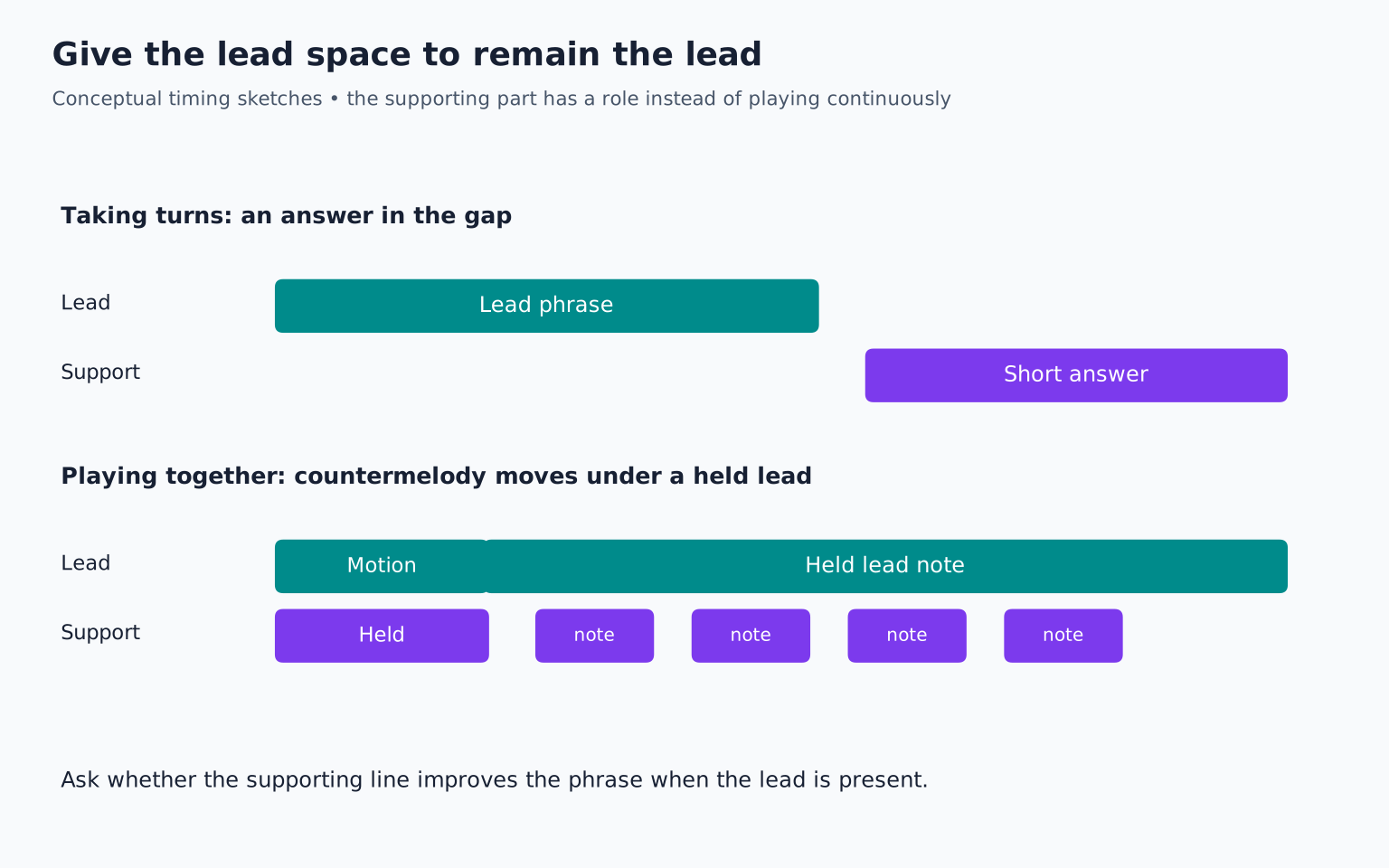
In the gap after the held vocal note, try a quiet guitar or synth response of two notes: E, F after bar 1, D, B after bar 2, and D, E after bar 3. Keep the response shorter and less prominent than the vocal phrase.
If the singer later adds a run, remove the instrumental response there. Production should adapt to the performance. A fill that was useful before the vocal arrived may become unnecessary afterward.
For background vocals, begin with a single harmony on the final word of a phrase. Choose a chord tone that supports the lead, then sing and listen rather than applying the same parallel interval mechanically across every note. Double important phrases selectively; full song doubling can reduce intimacy if it obscures the lead's detail.
Make section contrast without abandoning the pocket
Try an arrangement of 4 bar intro, 8 bar verse, 4 bar pre chorus, 8 bar chorus, 8 bar verse, 4 bar pre chorus, 8 bar chorus, 4 bar bridge, 8 bar final chorus, and 4 bar ending. At 76 BPM, the 60 bars last about 3 minutes 9 seconds.
For the verse, use the keyboard, bass, rim, and guide vocal. In the chorus, add a sustained pad, stronger snare layer, and selected harmonies. In the bridge, remove the drums and hold the A minor harmony longer before returning to D minor.
The chorus need not be much louder. A higher melody, longer notes, or clearer backing vocal response can create the lift. Leave the final chorus's most expressive addition until that return.
Mix for words and expression
Start with the lead vocal and build the accompaniment around it. If the keyboard covers the words, reduce its level, simplify its voicing, or remove attacks under important syllables. Equalization can help, but arranging less competition is often more natural.
Use reverb to establish space without burying consonants. A delay throw on a phrase ending can provide atmosphere while keeping the main line relatively direct. Check breaths and edits for abrupt changes, but do not erase all signs of performance.
Export a full draft and listen specifically to the singer's story. Your exercise is to mute every instrumental fill, then restore only those that improve the vocal conversation. Continue with countermelodies and chorus contrast as the song develops.
TAKE IT INTO YOUR OWN MUSIC
Your next session.
Start with the lead vocal and build the accompaniment around it. If the keyboard covers the words, reduce its level, simplify its voicing, or remove attacks under important syllables. Equalization can help, but arranging less competition is often more natural.
Notes and progress stay in this browser.