This tutorial builds an original rolling, melodic example at 172 beats per minute in 4/4. It uses programmed drums rather than requiring a sampled classic break. For a break chopping centered approach, use the jungle tutorial.
Make the anchors clear
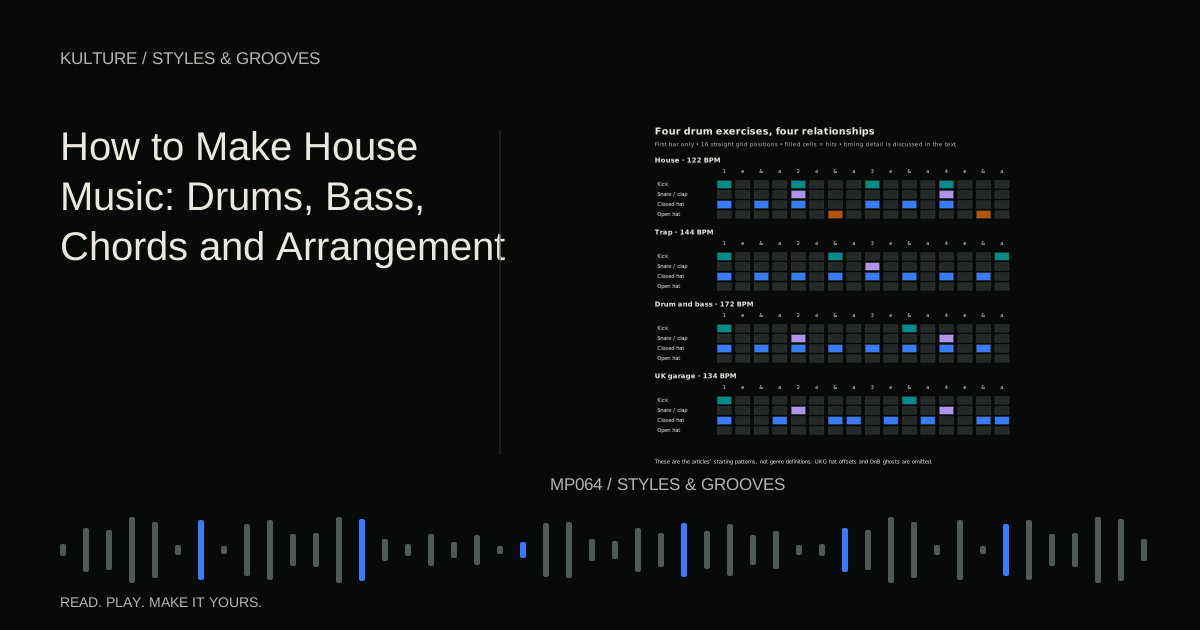
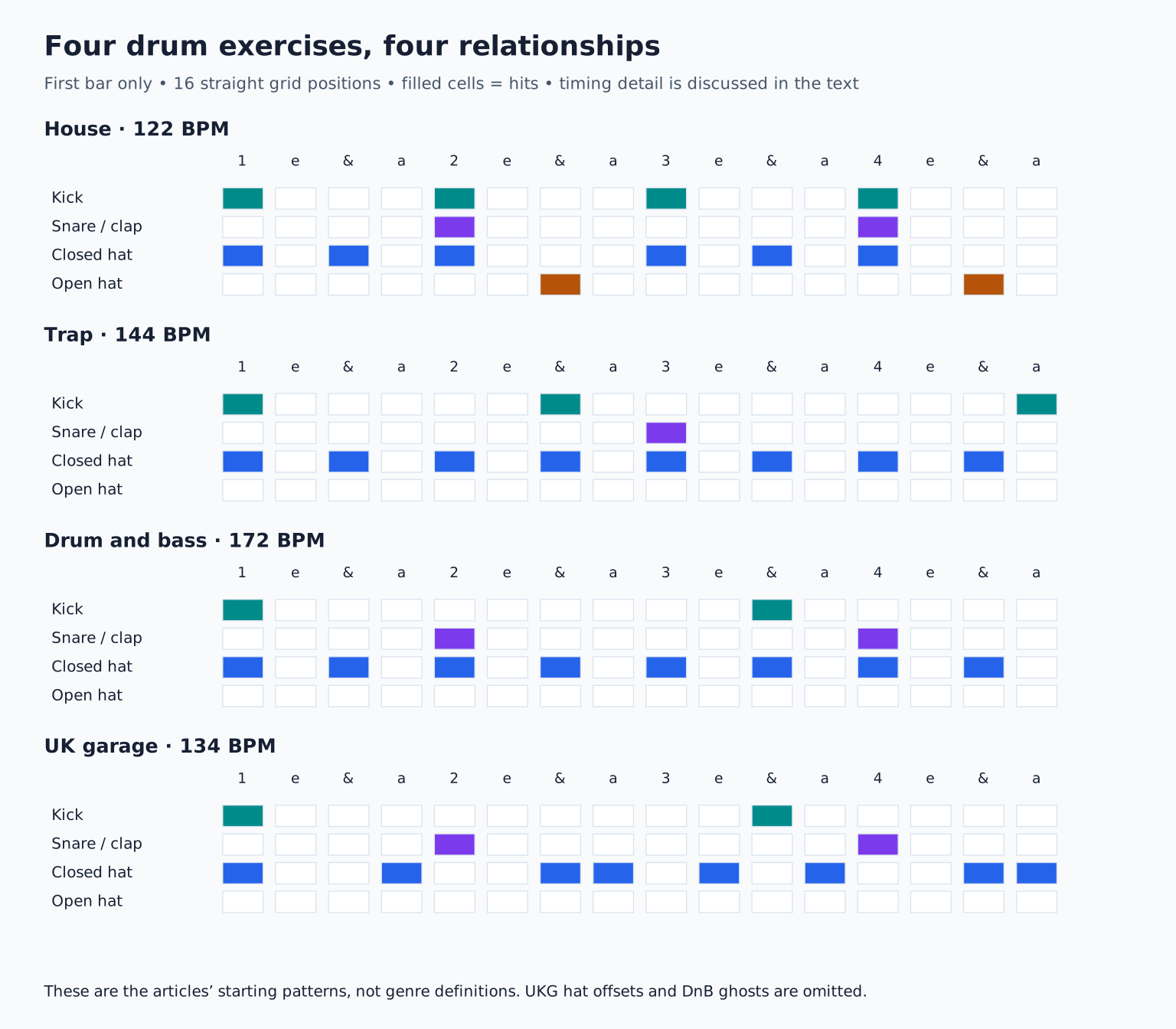
Create a two bar drum pattern. Put snares on beats 2 and 4 in each bar. Add kicks at these positions:
- Bar 1: beat 1 and beat 3 and.
- Bar 2: beat 1, beat 2 a, and beat 3 and.
At this tempo, a quarter note lasts about 349 milliseconds. Short drum envelopes can help preserve the space between hits, but do not shorten every sound until the kit loses body.
Add closed hats on eighth notes. Make some offbeat hats slightly stronger and vary the quieter ones. The snare should remain the clearest backbeat; the hats should describe motion around it.
Native Instruments' drum and bass walkthrough provides another example of combining drums, bass, and atmosphere. Its plugin choices are optional; the arrangement principles do not depend on a particular bundle.
TRY IT HERE
Find the pocket
Tap the grid, change the tempo and hear your pattern.
Ready when you are. Audio starts only when you press Play.
Keep experimenting in the beat maker LabAdd ghost notes that lead somewhere
A ghost note is a quieter percussion hit that supports the groove rather than acting as a main accent. Add a quiet snare on bar 1, beat 3 e, and another on bar 2, beat 4 a. Use a softer sample or a lower velocity, depending on how your drum instrument responds.
Listen with only kick and snare. The quiet hits should create a rolling connection into the main accents. If they sound like additional backbeats, lower them or change their tone. If they create clutter, remove one before adding processing.
Now add a short shaker pattern in sixteenths, with gaps around the strongest snare hits. Do not keep every subdivision equally loud. The ear needs a hierarchy: main backbeat, secondary accents, and texture.
A slightly different timing feel on the shaker can add life, but avoid randomly moving all drum hits. Keep the central pulse reliable and make each deviation intentional.
Build a bass phrase with a readable contour
Use G minor as the tonal center. Start with a simple monophonic bass and these two bars:
| Bar | Position | Note and duration |
|---|---|---|
| 1 | 1 | G for one beat |
| 1 | 2 and | G for half a beat |
| 1 | 3 and | D for half a beat |
| 2 | 1 | E flat for one and a half beats |
| 2 | 3 | F for half a beat |
| 2 | 4 and | G for half a beat |
This phrase has a stable G opening and an E flat, F, G answer. The bass does not need to be fast merely because the drums are fast. Leave the rests intact while choosing the sound.
For a rounded tone, use a sine or triangle foundation with a quiet harmonically richer layer. For a rougher tone, try a filtered saw based patch. If you separate sub and midrange layers, keep their note starts and pitch behavior coordinated. Two uncoordinated low layers can cancel or become unstable.
Create movement without obscuring the notes
Automate a low pass filter or a wavetable position on the midrange bass layer. Change the timbre across a two bar phrase while preserving the underlying pitch and rhythm. Start with a small range so the sound does not turn into a different instrument on every note.
Render one pass to audio if you want to edit its best gestures. Rendering commits the instrument's current output to an audio file. Keep the MIDI and synth version muted as a reversible source.
Cut the rendered phrase at intentional gaps, not through exposed waveform peaks. Add small fades where necessary. Rearrange one response in the fourth repetition, while preserving the opening G gesture so the phrase remains recognizable.
If a bass sound is exciting alone but masks every snare, simplify its high frequency movement or leave more space. A spectacular solo patch is not automatically a useful part.
Add harmony at a slower pace
Create a pad with G, B flat, D for four bars, then E flat, G, B flat for four. Use a slow attack and a release that does not smear the chord change excessively. The slower harmony gives the rapid drums a stable emotional background.
Add a small upper motif only every four bars: D on beat 1, F on 2 and, G held from beat 3. In the E flat section, use B flat, G, F. Keep this line out of the bass's most active moments.
The point is contrast in timescale. Drums can change in fractions of a second while harmony evolves over several seconds. If every layer changes equally fast, the track may become tiring rather than energetic.
Turn eight bars into a full track
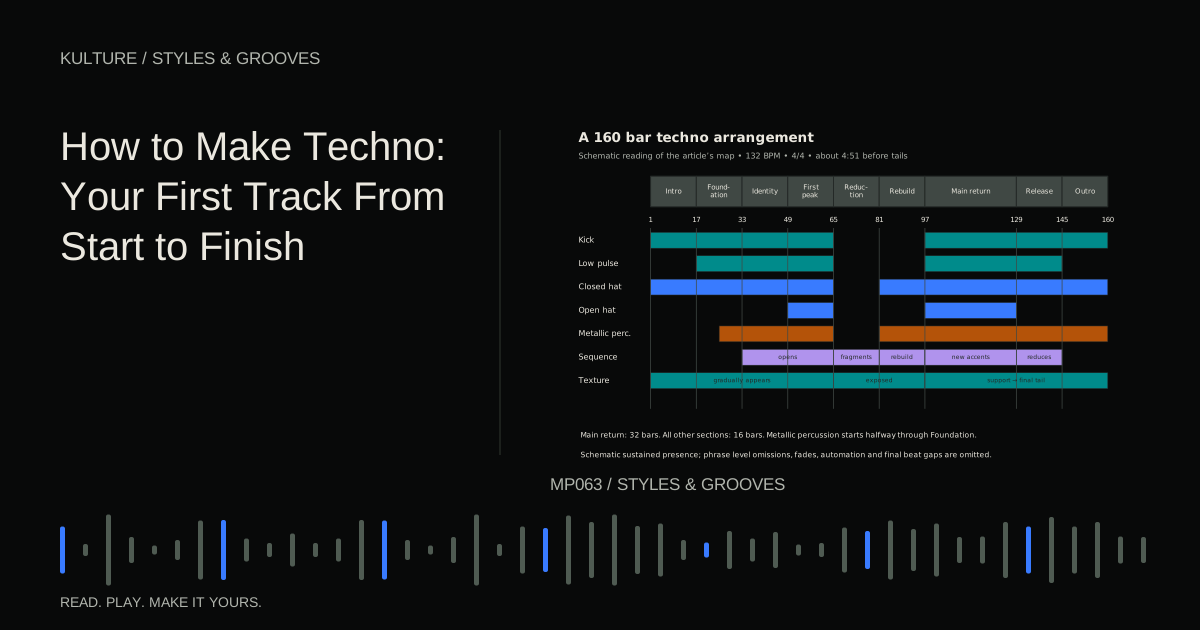
Try this 160 bar map, about 3 minutes 43 seconds at 172 BPM:
- 1 to 16: pad and a filtered percussion fragment.
- 17 to 32: drums develop, with the bass opening teased sparsely.
- 33 to 64: first full section.
- 65 to 80: reduce drums and expose the harmonic motif.
- 81 to 96: rebuild, using fewer low notes until the arrival.
- 97 to 144: main return, with a changed bass response after sixteen bars.
- 145 to 160: strip back to drums and atmosphere, then end deliberately.
Every eight or sixteen bars, make one meaningful change: remove a kick, alter a ghost note fill, answer the bass differently, or briefly expose the pad. Avoid a new fill every bar unless that density is part of the intended style.
Check the fast details carefully
At high tempo, long cymbal and snare tails can overlap more than you expect. Listen to the drum bus alone, then in context. If the hats sound like continuous hiss, reduce sustain or density before using aggressive equalization.
If the snare loses impact when bass enters, inspect frequency overlap and simultaneous bass attacks. A small rhythmic gap may solve more than heavy compression. If the bass feels too quiet on smaller systems, add controlled harmonics rather than forcing the deepest frequencies louder.
Compare sections at similar playback loudness. A louder return can seem better even if its rhythm is less clear. Export and check the entire ending, including pad and delay tails.
Your practical test
Make two versions of the same eight bars: one with only anchor drums and one with all ghost notes and shaker detail. If the detailed version does not improve forward motion, remove half its extra hits. Then vary only the final bass response. This teaches the essential balance between a stable groove and evolving detail. Continue with bassline variation when the pattern needs development.
TAKE IT INTO YOUR OWN MUSIC
Your next session.
Make two versions of the same eight bars: one with only anchor drums and one with all ghost notes and shaker detail. If the detailed version does not improve forward motion, remove half its extra hits. Then vary only the final bass response. This teaches the essential balance between a stable groove and evolving detail. Continue with bassline variation when the pattern needs development.
Notes and progress stay in this browser.