This tutorial creates an original mid tempo electronic pop sketch at 108 beats per minute. Its working title is “Leave the Light On,” used here only as an original practice phrase. Begin with a guide vocal and a keyboard rather than trying to finish the drums before you know the song.
Write the chorus before decorating it
Use C major and a four bar progression: F, C, G, A minor. The chord notes are F, A, C, C, E, G, G, B, D, and A, C, E. Play one chord per bar in a comfortable middle register.
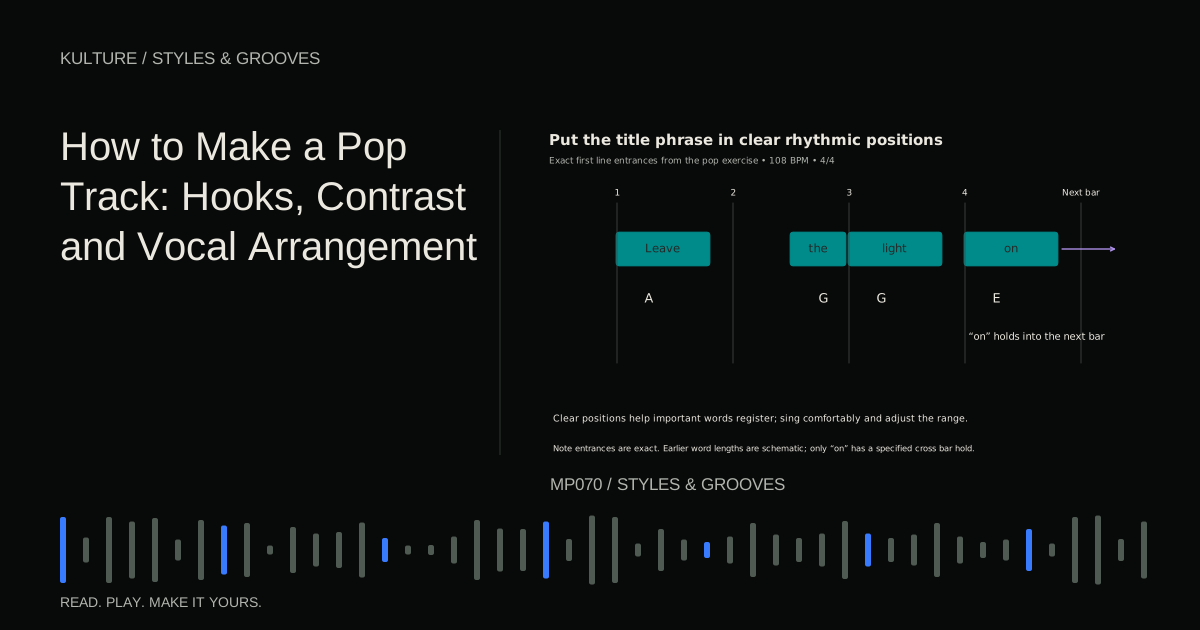
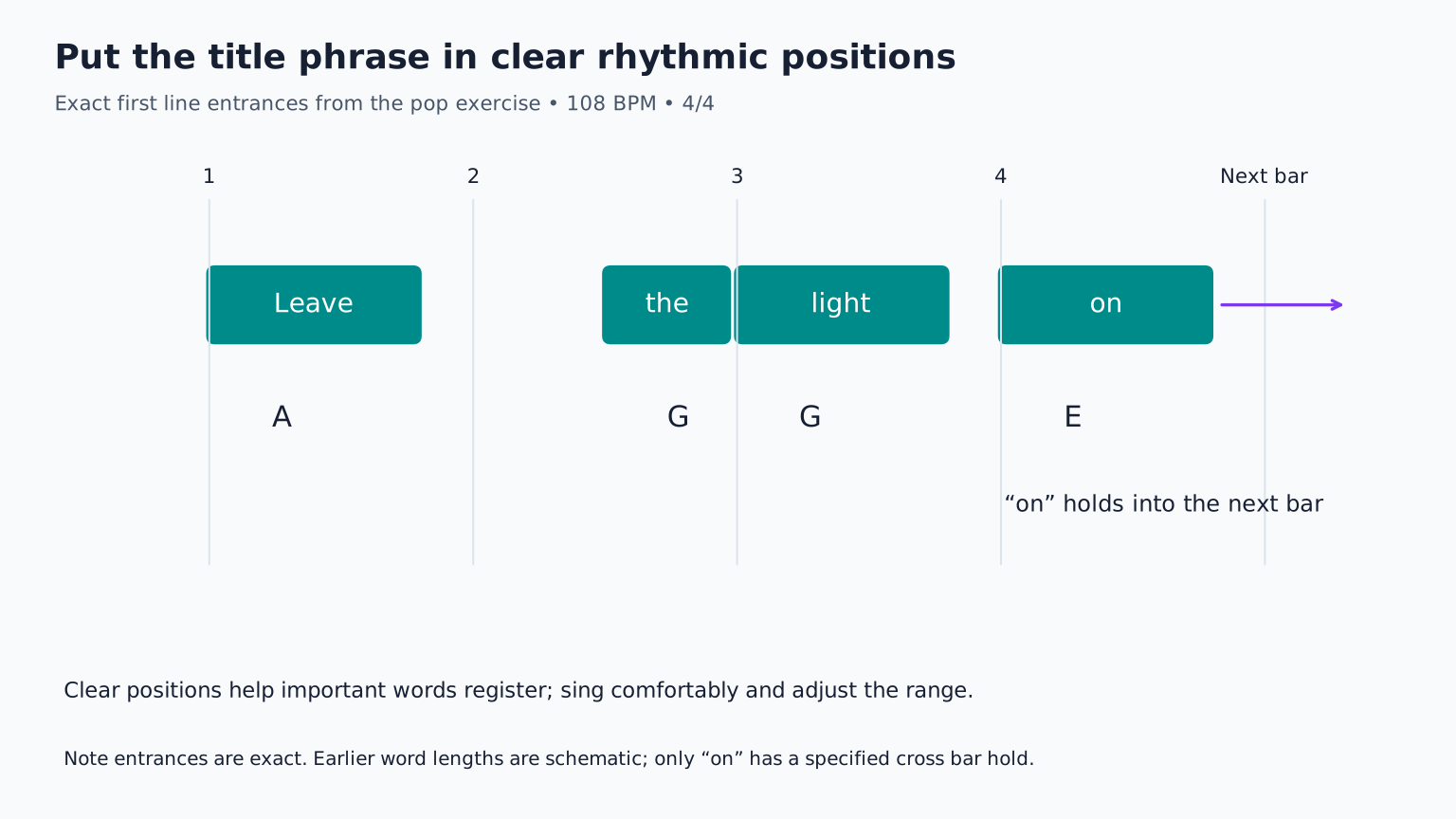
For the first line, sing “Leave the light on” with this rhythm: “Leave” on beat 1, “the” on 2 and, “light” on beat 3, and “on” on beat 4, held into the next bar. Try notes A, G, G, E, adjusting the range to your voice. The important words receive clear positions and enough duration to register.
Answer with an original second line such as “I can find my way.” Speak it naturally before assigning notes. Do not squeeze it into the first line's rhythm if the stresses become awkward. A repeated rhythmic idea can include a small variation.
Berklee's prosody lesson offers a useful principle: musical choices should support the song's expression. For this sketch, decide whether the lyric feels reassuring, uncertain, or pleading. That decision should guide the vocal delivery and harmony more than a preset labelled “pop.”
TRY IT HERE
Find the pocket
Tap the grid, change the tempo and hear your pattern.
Ready when you are. Audio starts only when you press Play.
Keep experimenting in the beat maker LabMake the verse do a different job
Use C, G, A minor, and F for the verse, one bar each. Keep the melody mainly around E and G, lower and more conversational than the chorus. Use shorter notes and more rests.
Write a concrete scene rather than repeating the chorus's general statement. For example, “Your coat is hanging by the door” gives an image that can lead toward the title. You can revise the wording later; for now, test whether the verse creates a reason for the chorus to arrive.
Record two verse lines over eight bars. If the story feels rushed, remove words or lengthen the section. Do not add more instruments to distract from a lyric that cannot be sung comfortably.
Build the drum part around vocal rhythm
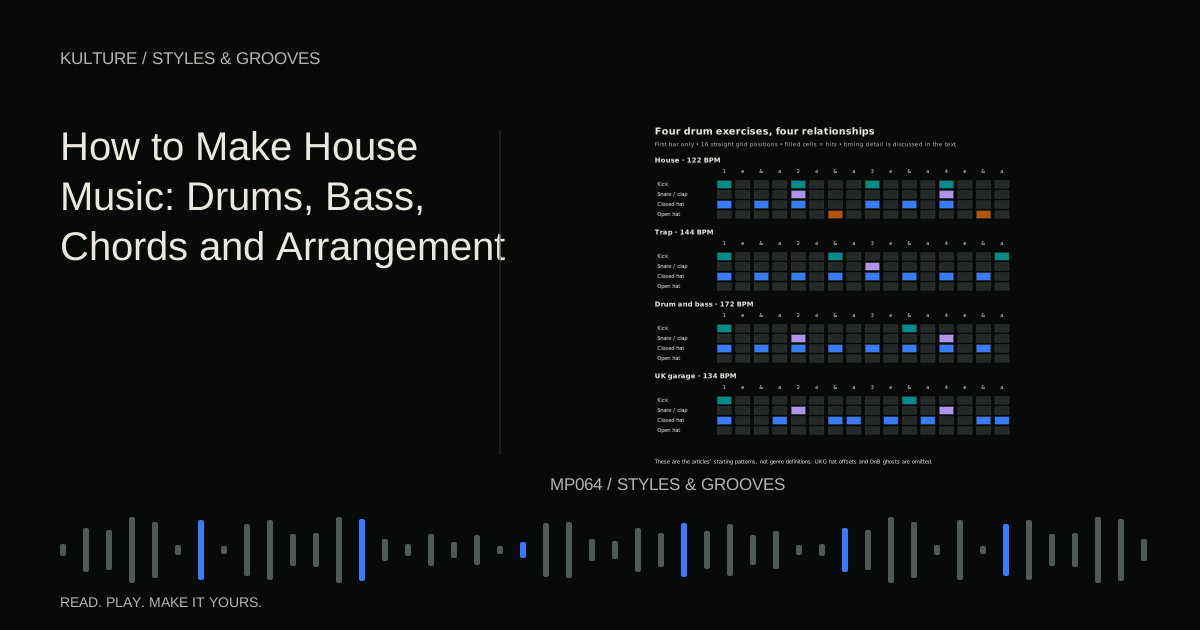
Place a kick on beats 1 and 3, with a second kick on 3 and in every other bar. Put snare or clap on 2 and 4. Add closed hats on eighth notes, with quieter hits on the numbered beats.
In the verse, omit the extra kick and use a softer rim layer instead of the full snare. In the chorus, restore the stronger backbeat and add a short open hat on selected offbeats, replacing any closed hat at the same position.
Listen to the guide vocal and drums alone. If a fill interrupts the title phrase, move it to the end of the second or fourth bar. The drums should reinforce phrasing, not advertise every programming trick at once.
Write a bass that clarifies the chords
For the chorus progression F, C, G, A minor, start each bar on its root. Use a quarter note root on beat 1, an eighth note root on 2 and, and a fifth on beat 3. Leave beat 4 relatively open for the lyric's sustained ending.
The fifths are C, G, D, and E. In the fourth bar, add G on 4 and as a short pickup back to F if it suits the melody. Keep the bass register low but intelligible; exact octave labels vary across software.
For the verse, simplify to one or two notes per bar. This makes the chorus feel more active without requiring a level jump. If the chorus is already rhythmically busy, reverse the strategy and let the bass sustain more simply there.
Choose one instrumental signature
Add a short synth or guitar figure that listeners can associate with the song. Try C, D, E on beat 3 and, 4, and 4 and during the intro. Bring it back between chorus lines only where the vocal rests.
Do not run the figure continuously beneath the lead. A signature sound gains power through placement. If it appears in the intro, chorus gaps, and ending, it can connect the whole song without occupying every bar.
Use one main chord texture and one supporting layer initially. A bright pluck can provide attack while a quiet pad sustains harmony. If both play the same dense voicing loudly, they may add masking rather than depth.
Plan the vocal arrangement by function
Keep the main verse vocal relatively exposed. Add a double on the chorus title phrase, recorded as another performance rather than merely duplicating the same audio. A copied track is not the same as a natural double and may only change level or phase.
Add one harmony on a held chorus word. Test chord tones against the lead rather than automatically singing a fixed interval above every note. Keep backing words aligned enough to avoid distracting consonant flams, while preserving some performance character.
For the final chorus, add an answering phrase after the lead finishes. Do not cover the main hook with an ad lib at its first appearance. Give listeners a chance to learn the central melody before elaborating it.
Arrange a complete, compact song
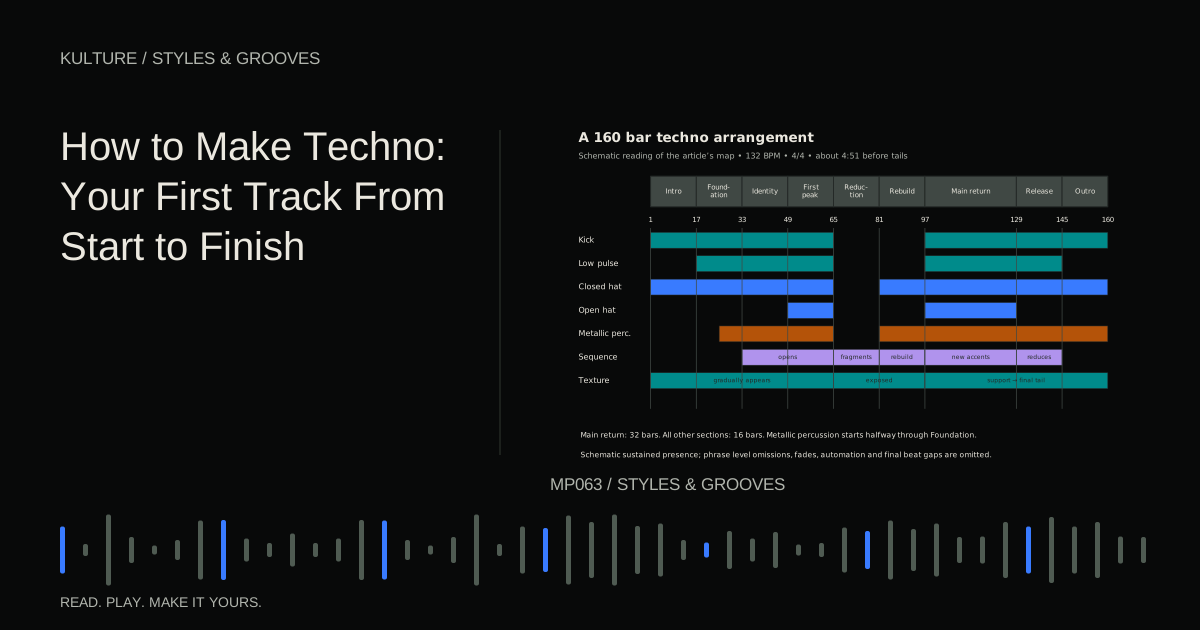
Use 4 bars of intro, 8 verse, 4 pre chorus, 8 chorus, 8 verse, 4 pre chorus, 8 chorus, 8 bridge, 8 final chorus, and 4 ending. The 64 bars last about 2 minutes 22 seconds at 108 BPM.
During the pre chorus, hold D minor for two bars and G for two. Reduce the bass rhythm and let the vocal rise. At the chorus, restore the full groove and the F chord. In the bridge, remove the main drums and change the lyric perspective before the final return.
These lengths are a draft. If the verse needs twelve bars or the title wants a shorter chorus, change the form. Song structure explained helps you evaluate section function rather than obeying a template.
Finish with the hook in focus
Balance the lead vocal first, then drums, bass, chords, and signature figure. If the hook is hard to understand, address competing parts before boosting the vocal aggressively. Check the first chorus entrance, the bridge transition, and the final title delivery.
Export and play the song once without looking at the screen. After a short break, try to sing the chorus from memory. If you remember only the production effect, the song may need a clearer melodic or lyrical center.
Your exercise is to make two chorus arrangements with identical vocals: one dense and one sparse. Choose the one that makes the title feel most convincing. Continue with chorus contrast and fitting lyrics to melody.
TAKE IT INTO YOUR OWN MUSIC
Your next session.
Balance the lead vocal first, then drums, bass, chords, and signature figure. If the hook is hard to understand, address competing parts before boosting the vocal aggressively. Check the first chorus entrance, the bridge transition, and the final title delivery.
Notes and progress stay in this browser.