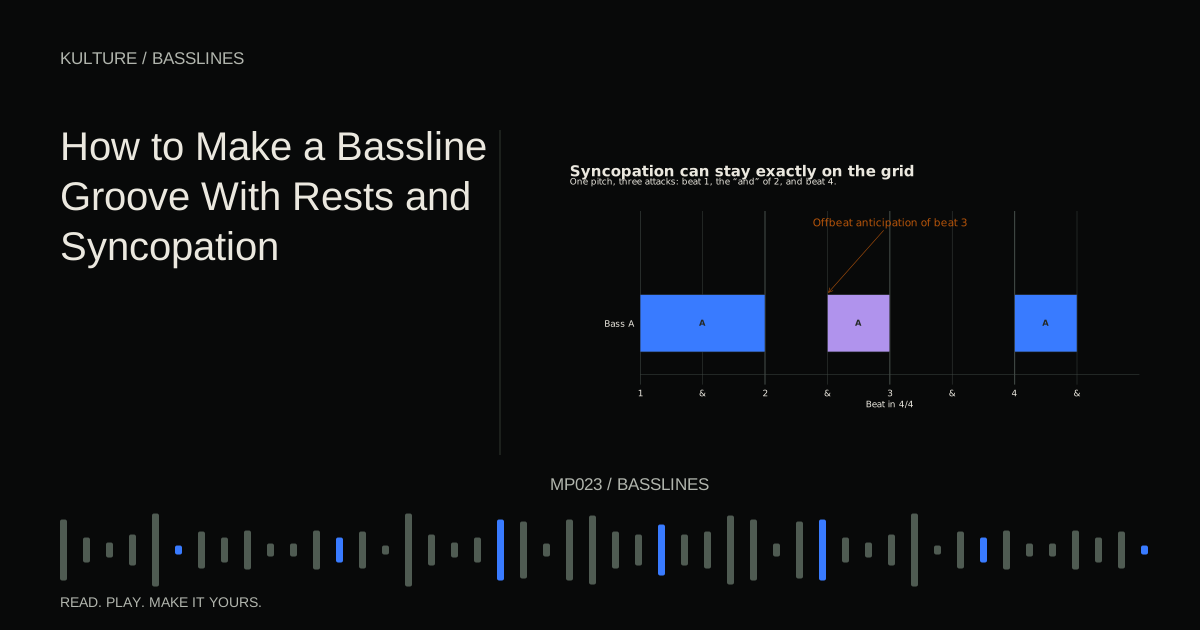
This approach is especially helpful when the chords or lead are already busy. You can create movement without introducing extra harmonic information.
Find the roots first
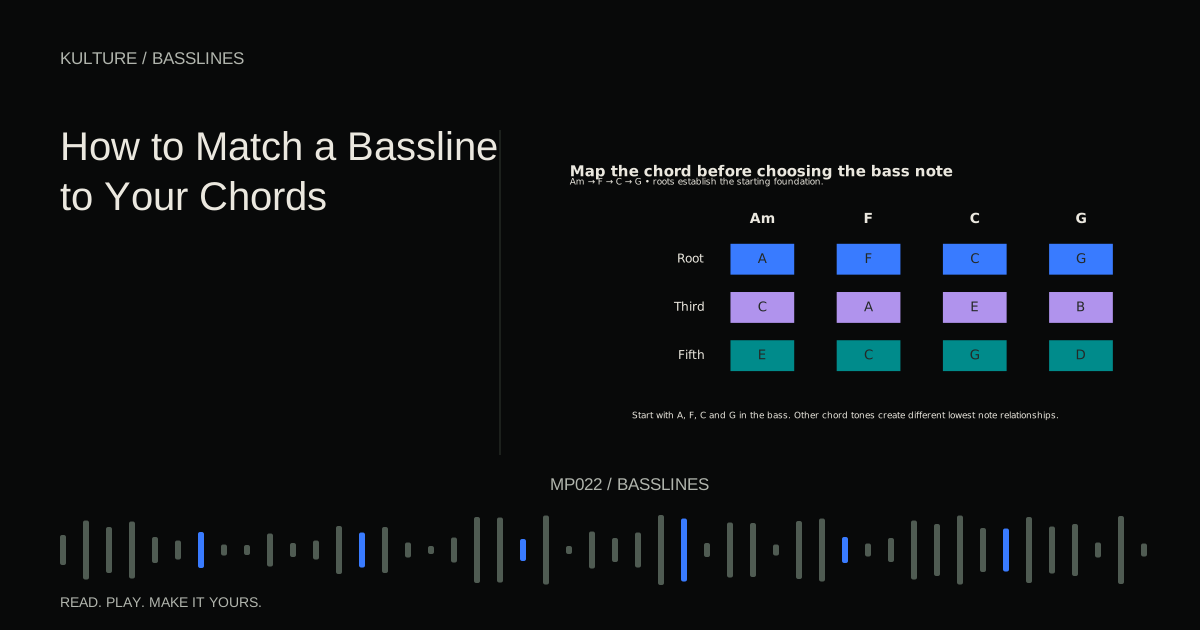
Use Dm, B flat, F, C, one chord per bar. The roots are D, B flat, F and C. Do not simply copy the lowest visible note of a chord voicing: an inversion may place another chord tone at the bottom.
For example, F, A, D is still D minor, even though F is the lowest note in that upper part. If you want a root based bassline, play D beneath it. If you deliberately play F, you create a different bass relationship.
The Open Music Theory triads chapter distinguishes chord identity from spacing. For a full introduction to writing the part, see How to Write a Bassline That Fits Your Track.
TRY IT HERE
Give the bass some space
Tap steps to add rests. Change the register or slide.
Ready when you are. Audio starts only when you press Play.
Keep experimenting in the piano LabPick a usable register
Load a plain bass instrument and create a four bar loop at 110 BPM in 4/4. As a concrete starting range, try MIDI notes 38, 34, 41 and 36 for D, B flat, F and C. These are relatively low notes; if the patch becomes indistinct, move the whole sequence up twelve semitones.
Do not rely only on labels such as D1 or D2, because octave names vary between DAWs. MIDI note numbers and relative movement are more precise for following an exercise.
The lowest possible note is not necessarily the best bass note. A higher register can communicate pitch and rhythm more clearly while leaving useful weight underneath. Choose the range by how it works in the track, not by how impressive the sub bass looks on a spectrum display.
Write the plain version
Place each root on beat 1 of its bar and hold it for two beats. Leave beats 3 and 4 empty. Play the chords above it and listen to the harmonic movement.
Next add another root on beat 3, lasting one beat. You now have a simple long, short shape. Keep the same rhythm in all four bars so you can judge the changing roots without additional variation.
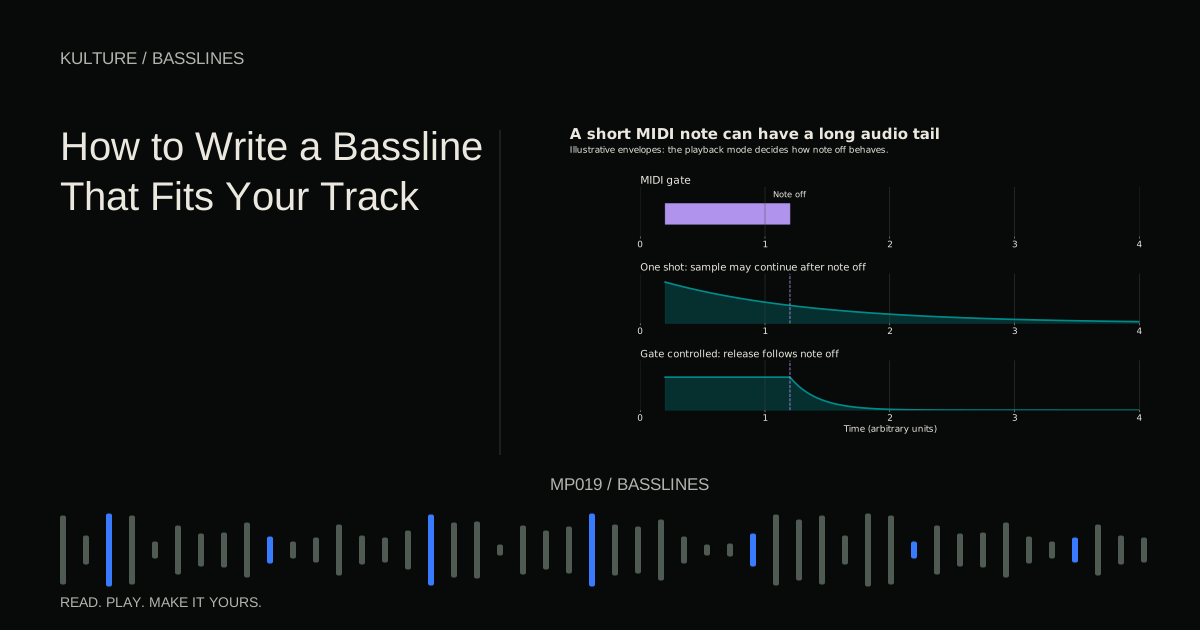
If the second note is not audible as a new attack, check the instrument's legato and envelope behavior. Some monophonic sounds connect nearby notes smoothly rather than restarting their attack. A tiny gap may restore articulation, but a retrigger setting may be the more direct control.
Add one octave answer
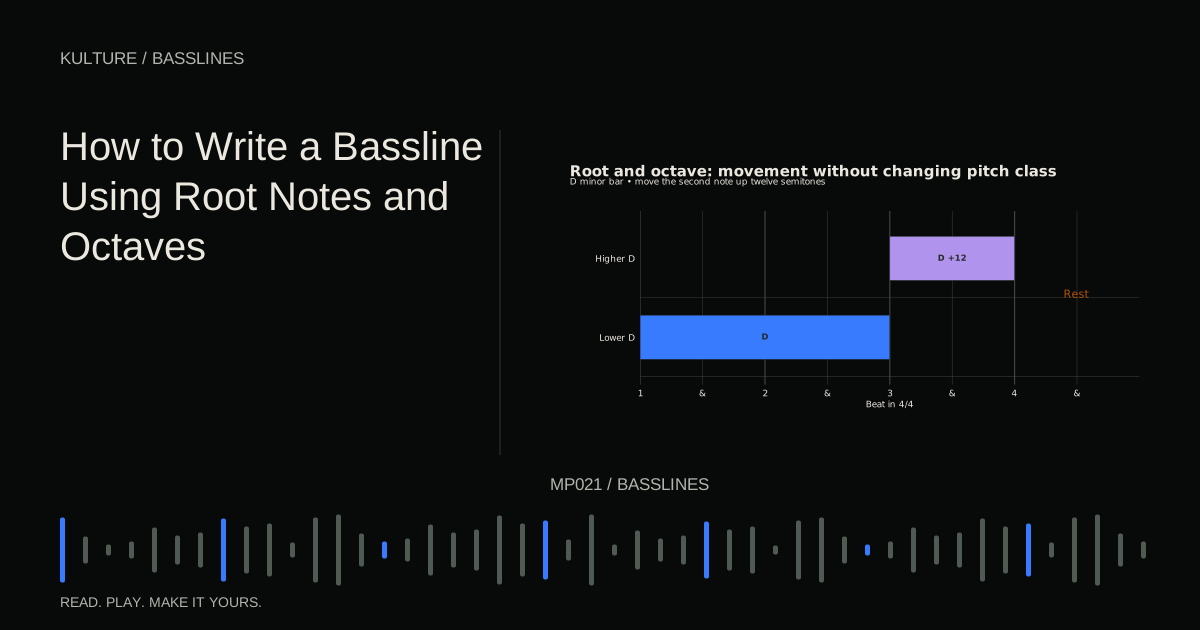
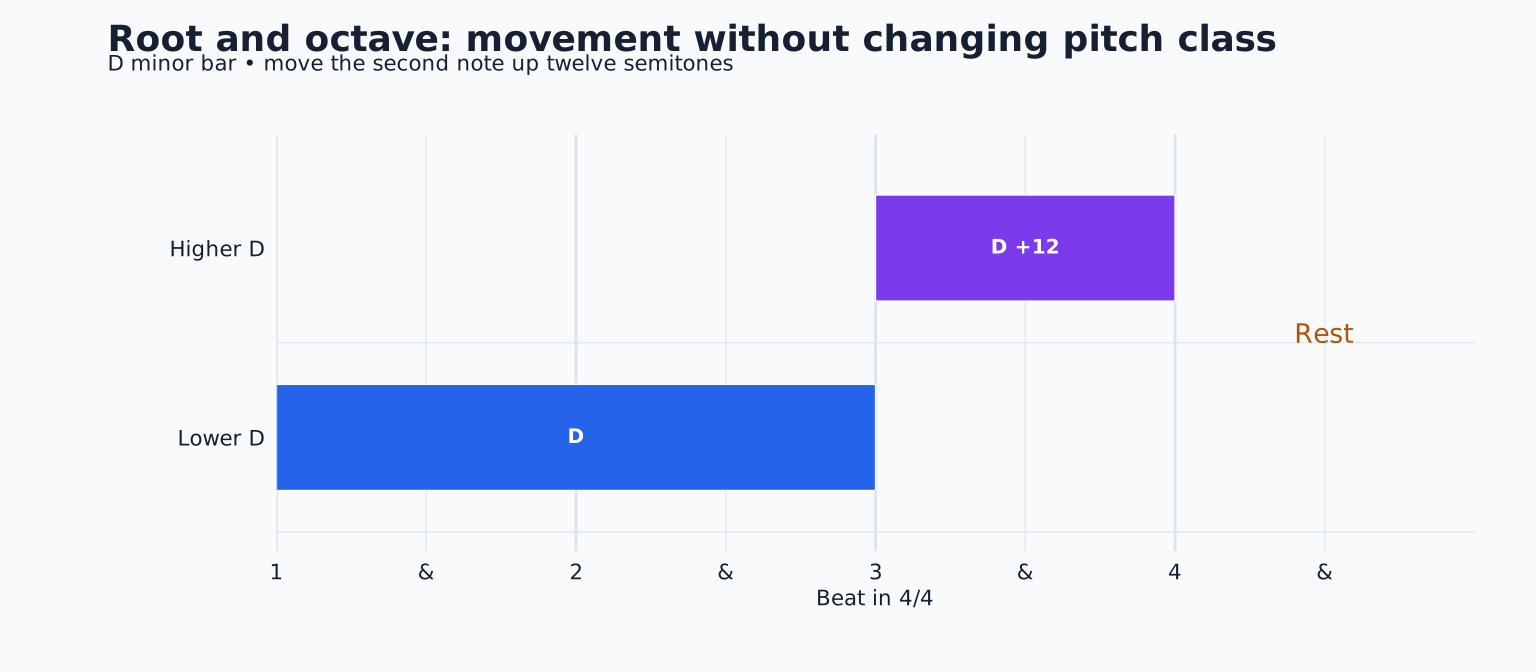
Duplicate the second note in each bar conceptually, but move that note up twelve semitones rather than adding another simultaneous note. Your D bar now plays low D on beat 1 and higher D on beat 3.
An octave is a two to one frequency relationship. It preserves the pitch class while changing register. In this pattern, the low note supplies weight and the higher note gives a lighter answer.
Listen to all four bars. The upper B flat might project more clearly than the low B flat, while the upper F might sound too bright in your patch. You can choose octaves individually to maintain a coherent range; the entire bassline does not need to jump by the same amount every time.
Ableton's bassline lesson is a useful external playground for hearing the interaction of low register pitch and rhythmic pattern.
Turn the octave into a rhythmic gesture
Move the higher note from beat 3 to the “and” after beat 2. Shorten it to an eighth note. The line now answers before beat 3 and then leaves a gap.
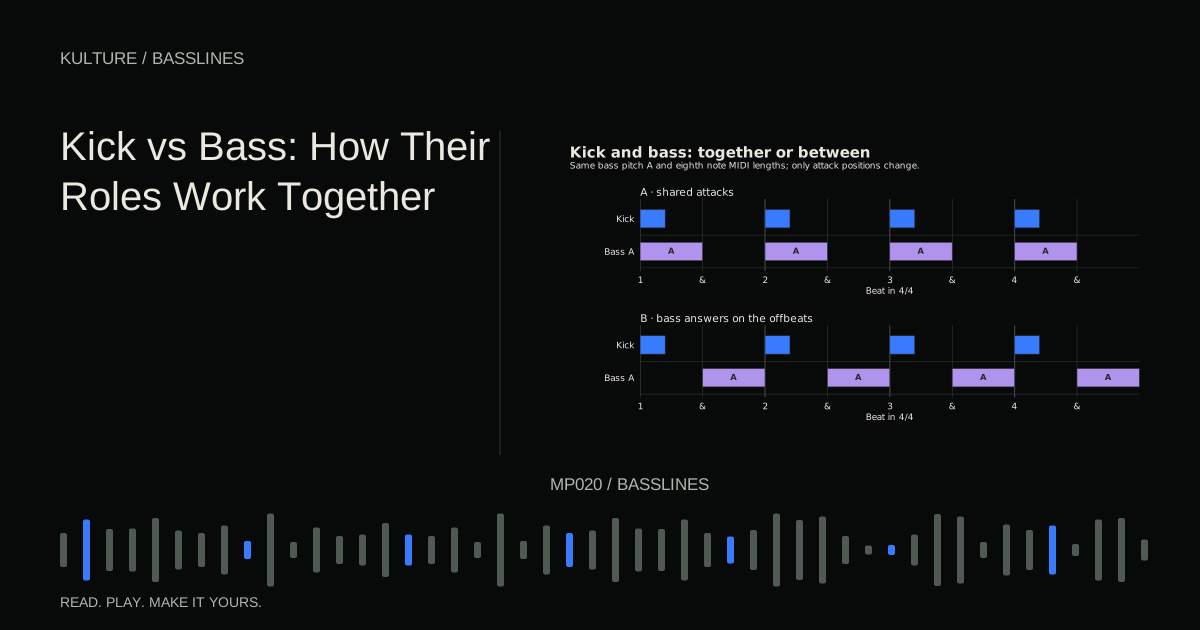
Count the bar as “1 and 2 and 3 and 4 and.” The first note starts on 1; the higher note starts on the “and” after 2. If a kick plays on beat 3, the bass can clear just before it, depending on the release tail.
Try a second rhythm: low root on beat 1 for half a beat, higher root on beat 2 for half a beat, low root on the “and” after beat 3 for half a beat. This more active pattern uses the same two pitches. Compare it with the restrained version while the full track plays.
Avoid the automatic octave bounce
Alternating low and high on every available subdivision can become predictable. Use the octave as an event rather than a default. Keep bars 1 and 2 low, add the higher answer in bar 3, and use two short octave gestures in bar 4 as a turnaround.
You can also reverse the order. Begin a phrase on the higher root, then land on the lower root for emphasis. That can make the low note feel like an arrival rather than constant background weight.
If the track has a strong vocal hook, reserve octave activity for gaps between vocal phrases. The bass remains supportive while still contributing a recognizable response.
Note length matters as much as pitch
Compare a short higher note with a sustained one. The short version may feel percussive; the sustained version can sound like a second melodic line. Neither is wrong, but their arrangement demands differ.
A sampler using speed based pitch changes may shorten the higher octave naturally. A synthesizer may keep the same envelope duration at both pitches. This means identical MIDI lengths do not guarantee identical audible shapes.
Adjust by ear. If low notes smear and high notes disappear too quickly, inspect the instrument's envelope or sample playback mode before editing the rhythm into an awkward shape.
Keep the chord changes clear
At the transition from D minor to B flat, make sure an old D does not continue unintentionally under the new chord. D belongs to B flat major, so the overlap may sound acceptable, but it changes the bass foundation from the planned root movement.
At the transition from F to C, a lingering F can create a stronger tension. If that tension is intentional, shape its resolution. If not, shorten the note or release before the new root enters.
Root based writing is simple only when the timing of the roots is clear. A correct pitch arriving late can make the harmony feel uncertain. Listen through each bar line rather than checking notes only within their own bars.
Troubleshooting the two note palette
If the line is boring, change one rest or duration before adding more pitches. If it is jumpy, reduce how often the octave appears. If the upper note steals attention, lower its velocity or choose a darker articulation.
If the low notes are hard to hear, test a higher overall register and a sound with some upper harmonics. Do not automatically turn up the sub bass until it dominates the mix. If the line conflicts with the kick, compare simultaneous and alternating attacks using Kick vs Bass.
Finish an eight bar version
Write the four bar progression twice. Use roots only in the first pass. In the second, add one octave answer in bar 6 and a short high to low return in bar 8. Keep the other bars unchanged.
Listen without looking at the piano roll. Can you hear where the phrase develops? If yes, you have created variation with only roots and octaves. Next, learn How to Match a Bassline to Your Chords before adding thirds, fifths and passing tones.
TAKE IT INTO YOUR OWN MUSIC
Your next session.
Write the four bar progression twice. Use roots only in the first pass. In the second, add one octave answer in bar 6 and a short high to low return in bar 8. Keep the other bars unchanged.
Notes and progress stay in this browser.