You do not need a complicated progression. Four chords with a strong rhythm, sensible voicings and a clear melody can carry a complete song. This lesson builds one progression, transposes it, and then shows how to make it less predictable without making it confusing.
Choose a key for a practical reason
A key is a tonal center and the harmonic relationships around it. Choose one that suits the singer, instrument or sound you are using. If there is no practical constraint, D major is a useful learning example because it includes both white and black keys.
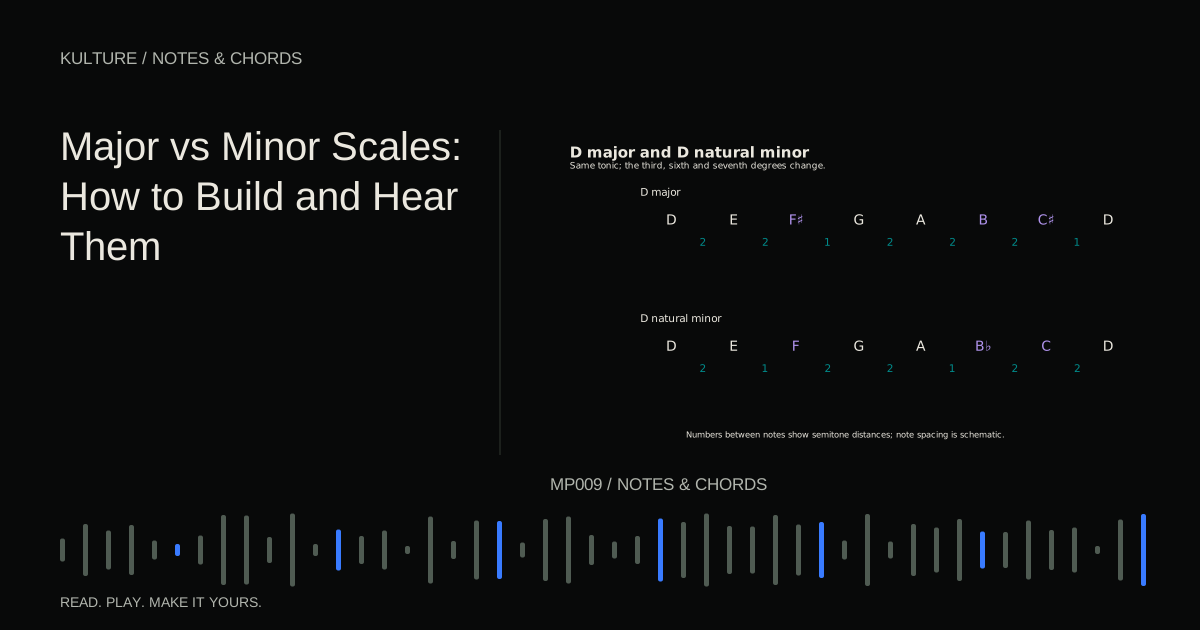
D major contains D, E, F sharp, G, A, B and C sharp. Build a triad from each note by selecting alternating scale notes. For example, beginning on E gives E, G, B. Measuring the intervals shows that this is E minor.
The major key pattern is:
| Degree | Roman numeral | Chord in D major |
|---|---|---|
| 1 | I | D major |
| 2 | ii | E minor |
| 3 | iii | F sharp minor |
| 4 | IV | G major |
| 5 | V | A major |
| 6 | vi | B minor |
| 7 | vii° | C sharp diminished |
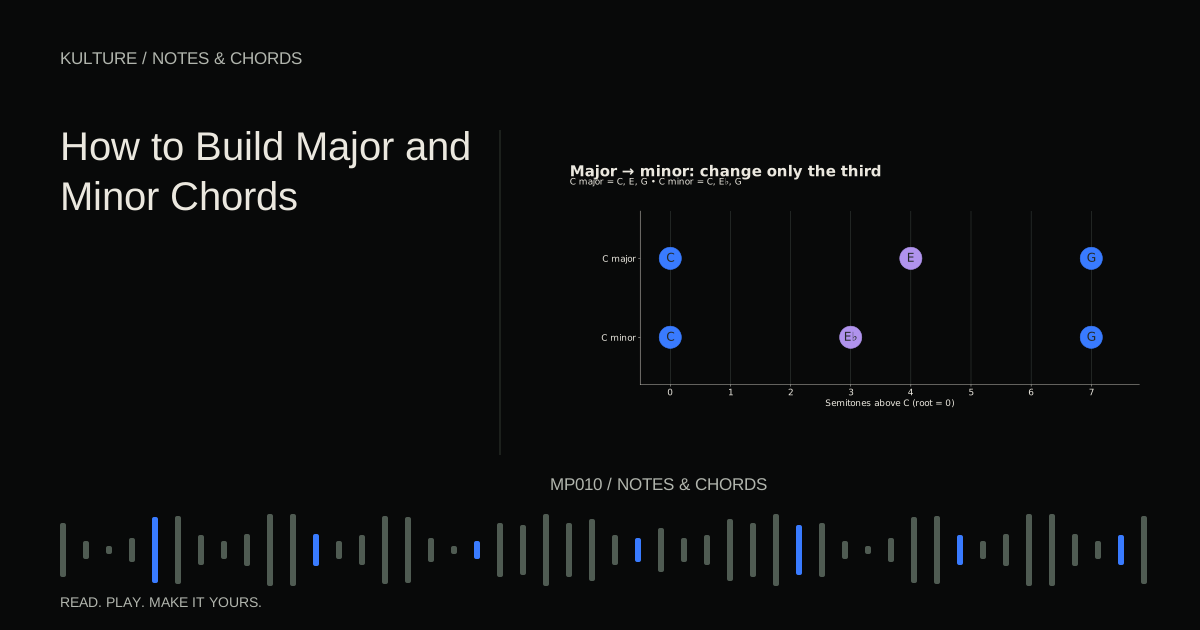
Uppercase numerals mean major triads here; lowercase means minor, and the small circle marks diminished. Open Music Theory's triad reference supports this major key quality pattern. For note by note construction, use How to Build Major and Minor Chords.
TRY IT HERE
Build it. Hear it.
Change one note and listen to the relationship.
Ready when you are. Audio starts only when you press Play.
Keep experimenting in the piano LabStart with a four chord route
Choose I, vi, IV, V. In D major, that gives D, Bm, G, A. Place one chord per bar in a four bar 4/4 loop:
- D: D, F sharp, A
- Bm: B, D, F sharp
- G: G, B, D
- A: A, C sharp, E
Use a simple piano or pad in a middle register. Play the loop several times. Notice whether the return from A to D feels like an arrival. Now stop on A and leave silence. Compare the sense of completion with stopping on D.
These are listening questions, not mandatory rules. Some music deliberately avoids a strong arrival, and a repeating production loop may create its identity through ambiguity. Still, a clear starting example makes later departures easier to judge.
Change the harmonic rhythm
Harmonic rhythm means how quickly chords change. It is separate from the tempo of the drum beat. At the same 100 BPM, changing chords once per bar feels different from changing them every two beats.
Make three copies of your progression. In the first, keep one chord per bar. In the second, hold D for two bars, then Bm and G for one bar each, and A for two bars. In the third, use D for beats 1 to 2 and Bm for beats 3 to 4 of bar 1, followed by G and A in bar 2.
Do not worry that the versions have different lengths. Listen to how much time the melody would have to settle over each chord. A slow harmonic rhythm can leave room for a busy melody. Faster changes can supply motion beneath a restrained melody.
Choose the version that supports the song's phrasing. A four bar loop is convenient, but it should not dictate every musical decision.
Move the progression to another key
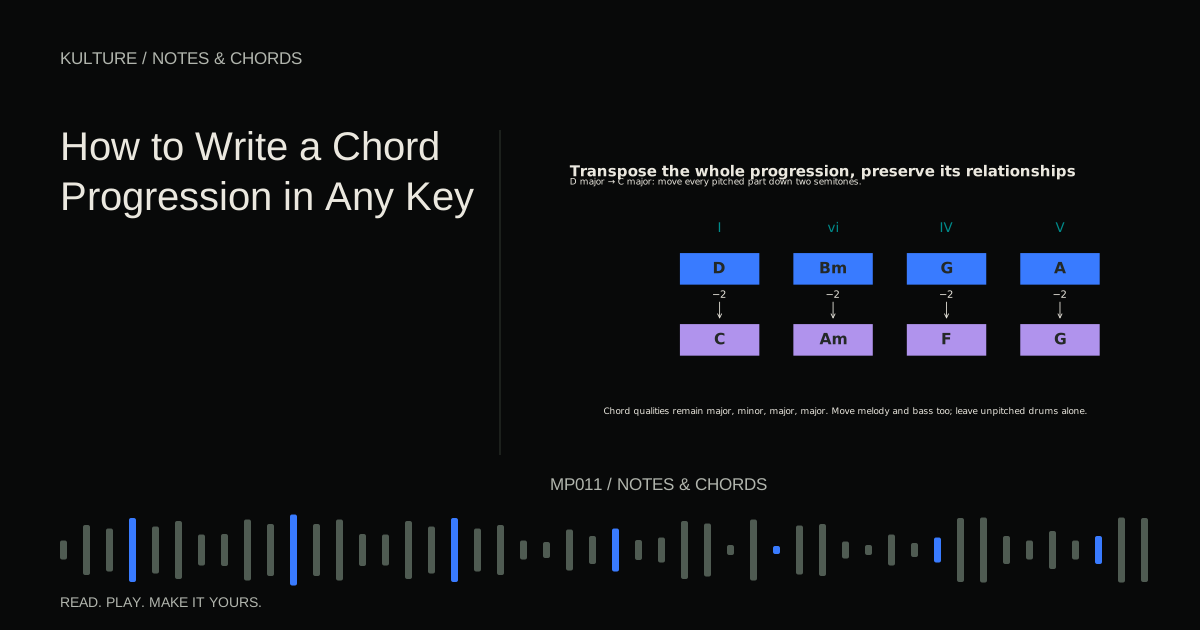
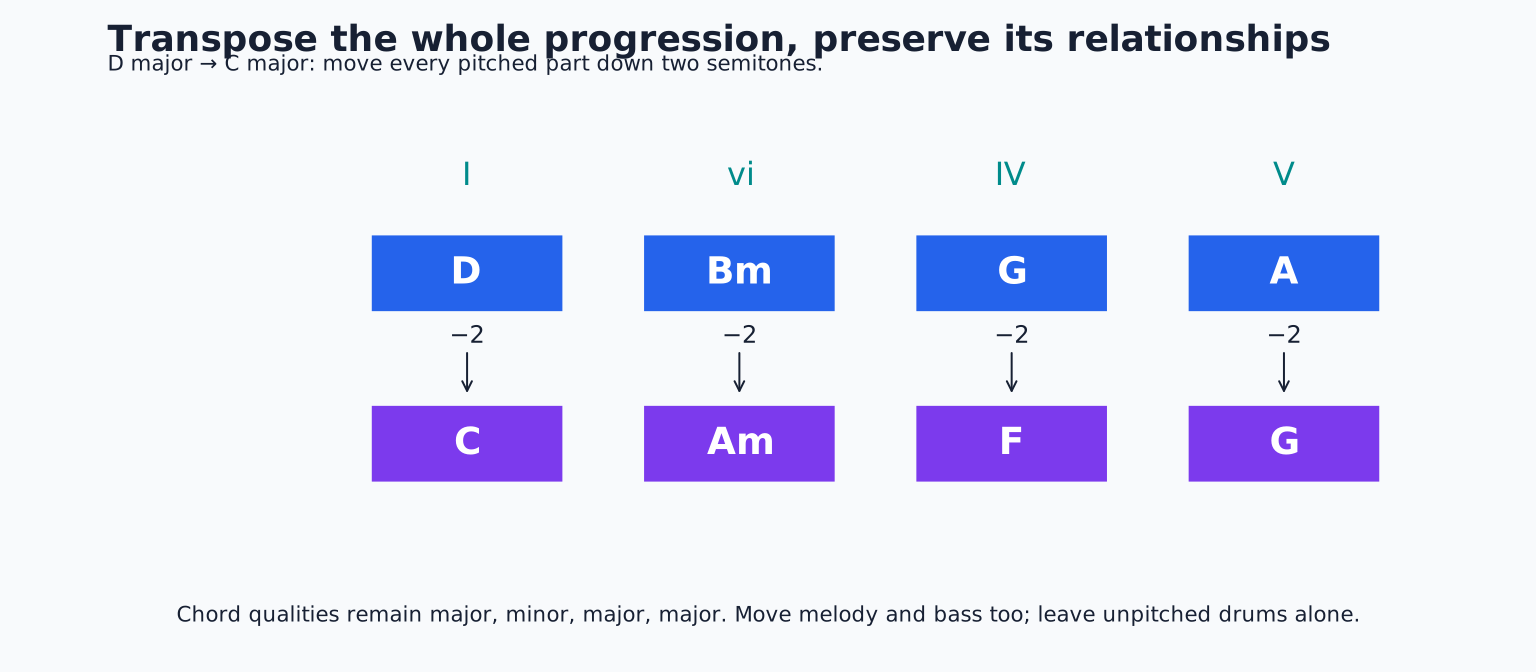
Suppose D major is too high for a singer. Move the complete pitched arrangement down two semitones to C major. D, Bm, G, A becomes C, Am, F, G. The roman numerals remain I, vi, IV, V.
If transposing manually, derive the new scale first: C, D, E, F, G, A, B. Select degrees 1, 6, 4 and 5 with the appropriate chord qualities. Do not change B minor into A major simply because the root moved to A; the quality must move with the chord.
When transposing an existing MIDI part, move every chord note the same distance. Check the melody and bass too. Unpitched drums normally do not need the same operation. Audio instruments may require a separate pitch shift process, and that can change their timbre, so audition the result.
Write a minor key version thoughtfully
Natural minor produces a different pattern of chord qualities. In A natural minor, the notes are A, B, C, D, E, F and G. A straightforward progression is Am, F, C, G, using roots on degrees 1, 6, 3 and 7.
Minor key numeral conventions vary. To avoid ambiguity here, use the chord names as the primary instruction. Some charts write this as i, VI, III, VII, counting from the minor scale; others use flattened numerals relative to major.
You can also try Am, Dm, E, Am. The E major chord contains G sharp, which is outside A natural minor but commonly used to strengthen the return to A minor. A minor key does not require every note to remain inside the natural minor collection at all times.
If this distinction is new, review Major vs Minor Scales before adding many altered chords.
Make the transitions smoother
Root position chords can jump a long way even when their musical relationship is simple. In the D major progression, use D, F sharp, A, then D, F sharp, B, then D, G, B, then C sharp, E, A. You have kept shared notes and moved others short distances.
The chord names are unchanged. Their upper parts now form smaller movements. Put a separate bass underneath with D, B, G and A if you want the roots clearly stated.
This is voice leading: treating each chord note as a line that moves into the next chord. A smooth voicing is not always the desired effect, but it is a useful alternative to sliding a fixed block shape up and down. Chord Inversions and Voice Leading takes this further.
If the progression feels generic
First ask what is missing. Is the sequence truly unsuitable, or have you only heard it on a plain piano for ten minutes? A recognizable progression can support a distinctive rhythm, melody, bassline and sound design.
Try holding the first chord longer, placing the last chord before the bar line, or changing the top note through inversions. These changes often create character without adding harmonic complexity.
If you want a new chord, replace one at a time. Swap Bm for Em in the D major example and hear D, Em, G, A. Then try ending on G rather than A. Record which change improves the emotional direction, not merely which one is less familiar.
Finish one usable progression
Create an eight bar sketch with D, Bm, G, A twice. On the second pass, change only the duration of the last A chord and the voicing of G. Add a root note bass and hum a melody over it. If the melody needs a different chord duration, edit the progression to support it.
Save the sketch in D major and a transposed copy in C major. You have now used chord construction, roman numerals, harmonic rhythm and voice leading in one practical task. The next step is to choose the version that works best for the actual instrument or voice in your track.
TAKE IT INTO YOUR OWN MUSIC
Your next session.
A key is a tonal center and the harmonic relationships around it. Choose one that suits the singer, instrument or sound you are using. If there is no practical constraint, D major is a useful learning example because it includes both white and black keys.
Notes and progress stay in this browser.